Showing posts with label Rusty Staub. Show all posts

Tuesday, June 16, 2020

Even More of the 1980 Donruss Set that Never Was

All-Stars, Leaders, Traded, World Series and Diamond Kings

Dave Winfield went 1 for 5 with one RBI and a run scored in the 1979 All-Star game. He grounded into a fielder's choice. With Gary Matthews on first and Mike Schmidt on third, Matthews was out at second and Schmidt scored. In his second at bat he doubled to the right field gap. He scored on a Gary Carter single.

Lynn's only at bat was a two-run homer off Steve Carlton scoring Don Baylor. That gave the American league a 3-2 lead in a back and forth game that was decided in the 9th inning. In the top og the 9th, Jim Kern (who was the 1979 Rolaids Relief Man award winner) walked the bases loaded. He was pulled for Ron Guidry who walked in the winning run. The NL won their 8th straight ASG 7-6.

For the 1980 All-Stars I borrowed the look from the 1990 Donruss MVP.  I added All-Star text to the background similar to the MVP. Although the 1990 is much more similar to the base. I ditched one of the banners to give it a cleaner look.

Correct me if I'm wrong, but I don't think Donruss ever had League Leader cards.  If they did, they weren't in the familiar Topps format. But for the sake of this imaginary set, I've created just that. I chose to do them in the Topps style from the '70s with a single card with the AL and the NL leader.

I picked this card because the Brothers Niekro actually tied for the most wins in 1979 with 21 wins each. Of course with knuckleballers you take the good with the bad.  Joe also led the league in wild pitches. Phil led the league in homeruns surrendered. In the AL Mike Flanagan had a career high 23 victories.  He also had career highs in shutouts  with 5 and strikeouts with 190. He was the AL Cy Young award winner.


Even though these guys led their respective leagues in homers, neither look too happy here.  Maybe because both of them also led their leagues in strikeouts.  Yup, Dave Kingman smashed 48 dingers and whiffed 131 times. In the AL, Gorman Thomas hit 45 round-trippers but fanned an incredible 175 times.

As for the traded cards, I reversed he players names and team names and tried to create a "traded" icon in the same vein as the "Rated Rookie" icon. A couple of big name trades here. Nolan Ryan was a free agent who signed a 4 year $4.5M with his hometown Astros.  He became the first player to earn more than $1M a year.  The Angels GM, Buzzie Bavasi reportedly commented that Ryan "could easily be replace by two 8-7 pitchers", referring to his 1979 record of 16-14.  


In 1980, Rusty Staub was competing with Warren Cromartie for first base. The Expos ended up dumping him for two nobodies at the end of  spring training. Rusty ended up sharing time as DH, first base and outfield for the Rangers. He hit an even .300 in a somewhat limited role. He was traded to the Mets the following season for the second time.
In some sets, Donruss did include World Series cards. But they weren't quite the same as we were used to with Topps.  They were visually similar to the player's card except with a World Series logo on the front. The back would detail their World Series feats.  I kept mine similar to Topps but included the World series logo.  In this particular card you can see Ed Ott easily tagging out Eddie Murray after a laser throw from Dave Parker.


It wasn't until their second issue in 1982 that Donruss included their Diamond Kings subset. But I've got one for the 1980 set. While Donruss relied on Dick Perez for their art, I tried to use photo effects to recreate the style.  Here is "Stretch" McCovey on a 1980 style Diamond Kings card.


******************************************
As usual, I am taking request for cards based on this design. So if there are any players or even subsets you'd like to see in a future post, leave a comment.


Monday, February 10, 2020

Cards That Never Were - 43rd & 44th Series Checklists

Still playing catch-up with the checklists.  The 43rd series contained mostly 1979 Alt-Topps cards. I included a shot of Rusty Staub AKA "le Grande Orange". He actually passed away in 2018, but a card commemorating his passing was requested in the comments.  In 1979 he began the season with Detroit.  In July of 1979 he was sent North of the border for cash considerations and a player to be named later (Randall Schafer). He played until 1985 with the Expos, Rangers and Mets.


The baseball community lost Mel Stottlemyre in January 2019. He is included on this 1971 Alt-Topps checklist. He played 11 years in the Majors, all with the Yankees. He was a five-time all-star.  The 44th series consisted of 24 cards from the 1971 Alt-Topps set and one Alt-Topps football card. It was a 1968 Alt-Topps design of Bart Starr.


 As usual, you can click here to see all the cards included in these series.  You can also click on any of the checklists in the margin.  This is great for looking at all my cards without all those annoying words slowing you down.


Friday, October 26, 2018

Cards That Never Were - 35th & 36th Series Checklists

Oscar Gamble and Rusty Staub


Just doing a bit of house-keeping here at CTNW.  The cards on these checklists date all the way back to July of 2016.  

I made the checklists in the 1983 design and included 2 of the greats that we lost earlier this year, Oscar Gamble and Rusty Staub.  Checklist 35 is populated with several cards from my other long neglected blog, Rating The Rookies.  It also contains many NFL/AFL Rookies of the Year and "Throwback Thursday" cards.


Checklist 36 is dominated by the 2016 post season cards I made. I took Hall of Famers that played for the 2016 post season teams. The twist was they were better known for wearing other teams' uniforms and I put them on cards from the year they were inducted into the Hall. I have to say, it made for some unusual looking cards. Also in that series were more Football ROY's and the missing manager cards from 1974.

If you wish to check out all the cards on these checklists without all these boring words getting in the way, click here.  Or, as always you can click on this (or any other) checklist in the right margin.  It will direct you straight to the page that contains all of these cards.

Saturday, October 20, 2018

1972 Alt-Topps Requests

To the people who read all the way to the bottom of my last post, here are your requests.  To be fair, I added that last paragraph about the requests 8 or 9 hours after I had first published my last post. This is just my way of saying thank you to all the other baseball card nerds.  Thank you for sharing my interests and even participating in them. 


I ended up making 11 cards in all.  Bill requested more All Stars so I included Bud Harrelson in what would be his only All Star start. Norm Cash actually started in place of  Boog Powell. Although Powell wasn't listed as injured, he only started in 8 regular season games in July of 1971. Despite going 0 for 2, Cash was good choice to fill in for Boog. First, he was playing in his home stadium. Second, he was hitting .293  with 20 homers in the first half of 1971.


I had a request for Ken Boswell from "Rumple" while "Buzz" gave me a laundry list. Above are the base cards. Staub could've been another traded, but since he wasn't dealt to the Mets until April, I kept him on the Expos.


I did give traded cards to Sudden Sam and McLain.  The shot of Denny wearing #52 must've been from spring training.  His familiar #17 belonged to pitcher Ron Klimkowski in 1971. Klimkowski didn't make Oakland's big league roster after spring training in 1972 and was released outright in May. McLain himself was dealt to the Braves for Orlando Cepeda in June after only 5 starts for the A's.


Both Baseball-Reference and The Baseball Almanac have him listed as wearing #17 during his short time with the A's.  I've seen pictures of him wearing 30, 31 and 52 but never 17.  Can anyone find a picture of him wearing #17 for the A's?


Another Buzz request was Frank Robinson.  I found this great shot and made it a Game 6 card.  So much going on in this photo.  First of course, you have Robbie scoring on a pop fly to shallow center off the bat of Brooks.  You also have Manny Sanguillen at the plate and in the foreground, batboy Jay Mazzone.  Mazzone had lost both hands as a 2 year old.  He joined the Orioles at 12 in 1966. 1972 was his final season.  


Wednesday, July 13, 2016

1986 All Star Game Honorary Captains: Rusty Staub & Charlie Gehringer

Before we even start, I admit that I cheated. I like the 1986 Topps set but absolutely hate the All Star cards in that set. So for my Honorary Captains series I took some of the elements of the 1986 All Star cards and used them to make a more consistent looking subset of the 1986 Topps set.

Less than a year after hanging up his cleats, Rusty Staub was named Honorary Captain of the NL. The All Star game was held at the Astrodome in Houston where Staub got his start. He was signed by the expansion Colt .45s in 1961 and played in Houston until he was traded to another expansion team, the Expos, in 1969. Rusty is the only MLB player to have over 500 hits with four different teams; Colt .45s/Astros, Expos, Mets and Tigers.  The Expos retired his number 10 in 1993. Montreal's retired numbers did not travel with the franchise to Washington. The Montreal Canadiens righted this wrong by hanging his number along with the numbers of Gary Carter, Andre Dawson and Tim Raines in the rafters of the Bell Centre. 
 Charlie Gehringer was the honorary captain of the American League. Gehringer was the starting second baseman in the the very first All Star game in 1933 (30 years before Staub's MLB debut). In fact he was the starting second baseman in the first six All Star games. He was the 1937 AL MVP but his best year was in 1929.  A year in which there was no AL MVP (or equivalent) award and was before the inception of the All Star game.He led the league in hits, doubles, triples, runs and stolen bases. He played all of his 19 seasons with Detroit. His number 2 along with Hank Greenberg's number 5 were the first to be retired by the Tigers in 1983. 
After winning just one All Star Game out of the twenty played from 1963-1982, The American League won their second in the last four games 1983-86. The tides were turning.

Just as it was in the 1985 game, the starting pitcher won the MVP. In 1985 it was LaMarr Hoyt, in 1986 it was Roger Clemens who got the start, the win and the MVP.  He pitch not just three scoreless innings but three perfect innings. The NL's starting pitcher Dwight Gooden got the loss and Orioles close Don Aase got the save. Lou Whitaker hit a two run homer in the second inning to put the AL ahead 2-0. Frank White added a needed insurance run  with a solo shot in the 7th. The NL rallied scoring two runs off of Charlie Hough in the 8th but fell short losing 3-2.

Thursday, January 28, 2016

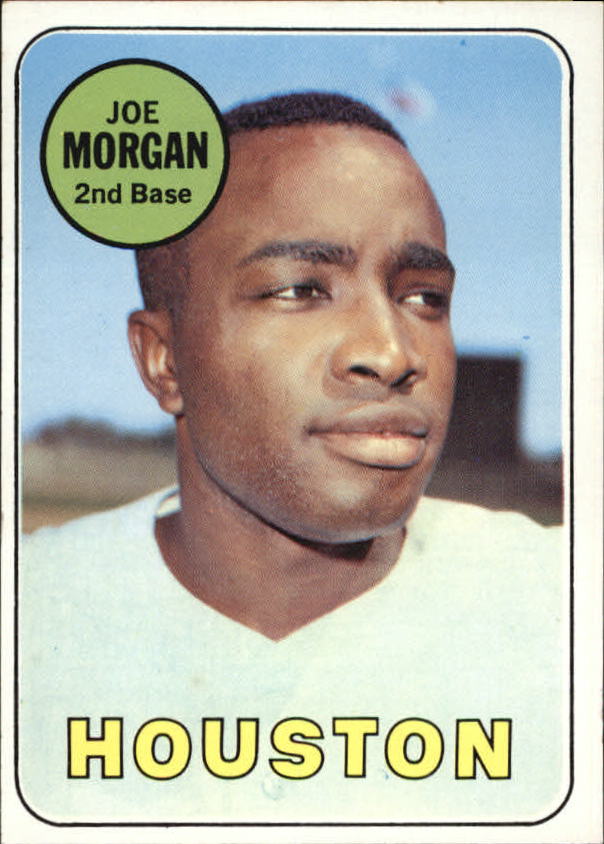
1969 Topps Deckle Joe Morgan

Houston Astros CTNW Favorites #4


Joe Morgan was one of early stars of the Houston Astros and to this day fans are bemoaning his trade as the worst in Astros history, perhaps baseball history. But hindsight is 20/20.

This was an eight player trade. The Astros gave up Morgan who hit .256 in 1971, first baseman Denis Menke and his .246 batting average, back-up outfielder Cesar Geronimo who hit .220 in limitedplay, pitcher Jack Billingham who went 10-16 in 1971 and a minor leaguer, Ed Armbrister.

In exchange they got second baseman Tommy Helms who was 2 years older and not a stolen base threat like Morgan, However he was coming off his 2nd consecutive Gold Glove year and had a similar .258 batting average. They got Lee May who was an all star in 1971 and had hit 38, 34 and 39 homers in 1969, '70 and '71 respectively. They also got Jimmy Stewart who was a career .306 hitting pinch-hitter and utility man. On paper it looked like a fairly even trade. At the time...

After the trade Billingham had back-to-back 19 win seasons in 1973 and '74. Geronimo became a Gold Glove center fielder and turned his .228 career batting average with the Astros into a respectable .261 with the Reds. And we all know what became of Morgan. In Houston, Stewart was released after the 1973 season. May's numbers declined and he was traded to Baltimore after the 1974 season. Helms lasted the longest. He was traded to the Pirates after the 1975 season for Art Howe.

Since Morgan was one of the bright spots of the early Astros teams, I had to dip into the insert sets to find a Card That Never Was for him. The 1969 Deckle set was a favorite of mine and of Topps, too. They revisited it in 1974 and most recently in the Archive sets from both 2012 and 2014. Topps did actually make a Deckle Edge card of Morgan inserted into the 2012 Archives set. But as you can see the photo they used is not from the 1969 era. It is clearly from his return to the Astros in 1980.


**********
UPDATE
**********
In the comment section, Brett brought up a good point. I called out Topps for using a photo from the wrong era, but my photo would not have been used by Topps in 1969 either. That is not unintended. I try to keep the photos historically accurate (or close to it) but I also want to make the cards look the way I would have wanted them. (Right under the title of this blog it says "What cards would look like if I had my way.")  Topps used all posed photos in the original 1969 Deckle set. But even Topps went to candid or "action" shots when using the design in their Archive sets.

Realistically, Topps would have used a photo like I posted below.  Due to a trademark dispute by Monsanto, in 1968 and the first 3 series of 1969 the word "Astros" didn't exist on Topps products, nor did any Astros logos. So most likely if Topps had made a card for Morgan it would have been a head and shoulders shot of him in his away uniform (Houston on front rather than Astros). It would also have had either no hat like Morgan's 1969 base card or an airbrushed hat like Rusty Staub and Jim Wynn had on their Deckle Edged cards.


 So if I wanted to make a card like Topps would have in 1969, I think it would look more like this. I didn't know how to include a picture into the comment section so here it is:


Monday, July 23, 2012

1975 Hostess Gary Carter

Montreal Expos CTNW Favorites #1


Although Gary Carter would have a Hall of Fame career behind the plate, most of his rookie season was spent in the outfield. The Expos primary backstop was Barry Foote. Foote was named to the Topps All-Star Rookie Team in 1974 and Expos manager Gene Mauch called him "the next Johnny Bench". Meanwhile "The Kid" was selected to the All Star team as an outfielder and finished second in Rookie of the Year voting. During his career he was selected to 10 more All Star teams (twice winning the All Star MVP) and won 3 Gold Gloves. All of them as a catcher.

On a side note, the 5 players I picked for my favorite Expos all had great nicknames. This wasn't deliberate, just a lucky coincidence.

"The Rock"


"The Big Unit"


"Rusty" and "Le Grand Orange"


"The Hawk"


"The Kid"


Thursday, July 19, 2012

1969 Topps Rusty Staub All Star

Montreal Expos CTNW Favorites #3


Rusty Staub was selected to his 3rd All Star team in 1969. He was the Montreal Expos' sole representative. He was also the only Expo selected in 1970 and 1971. In those 3 games as the sole Expo All Star, Staub would only see action once. In the 1970 All Star game he pinch hit for Tom Seaver. He popped out to short center and never took the field.

Staub spent only 4 seasons of his 23 year MLB career in an Expos uniform, but was well loved by the fans.  He was the first Expo to have his number retired. He would later be joined by Andre Dawson, Tim Raines and Gary Carter. Oddly both he and Dawson had the same number retired, 10. When the Expos became the Washington Nationals, the Expos retired numbers went back into circulation. The Montreal Canadiens honored the Expos by hoisting a banner of the retired Expos numbers at the Bell Centre.

Sunday, May 13, 2012

1973 Topps Rusty Staub


Last week in my post about Tommie Agee I pointed out that Rusty Staub made a guest appearance on his 1973 Topps card (airbrushed into an Astros uniform). Staub, however, didn't have his own Topps card in 1972 or 1973.  The 1973 set is one of my favorites. I especially like the horizontal action shots like Agee's. So I jumped at the chance to fill in Staub's missing 1973 card. If you'd like to see a 1972 Topps card of Rusty Staub follow this link to Mets Guy in Michigan.


Rusty Staub had an incredible post season in 1973. Although he had only 3 hits in 15 at-bats during the NLCS, all 3 of those hits cleared the fences. In the World Series he would bat over .400 and have a monster Game 4 going 4 for 4 with 5 RBIs and a homer to tie the series at 2 games each. That game was immortalized on cardboard in the 1974 set. Again using the horizontal action shot format.


Sunday, May 6, 2012

1966 Topps Tommie Agee


  Tommie Agee made his major league debut in 1962. He also saw limited big league action in 1963, 1964 and 1965 all before earning Rookie of the Year honors in 1966. Agee was well represented on Topps cards. He appeared on a 1965 "Rookie Stars" card the year before his R.O.Y. season and appeared on 2 cards in 1974 despite playing his final game in 1973.  After the 1973 season he was dealt from the Cardinals to the Dodgers. Topps made a 1974 card of him in a Cardinals uniform as well as a Traded card depicting him as a Dodger. Agee was cut by the Dodgers during spring training that year.

Perhaps the most interesting card of Tommie Agee is his 1973 Topps card. In it he is airbrushed into an Astros uniform along with two of his New York Mets teammates. One of whom is Rusty Staub.  Staub was conspicuously missing from Topps cards in 1972 and 1973 despite coming off an All Star season in 1971.