Showing posts with label 1963 Fleer. Show all posts

Tuesday, November 9, 2021

Roberto or Bob?

 In my last post I made a 1962 All Star card for Roberto Clemente.  I went back and forth on whether to use the name that Topps used for Clemente back in that era or his chosen name of Roberto.  I opted for the one that was more historically accurate. This caused some discussion in the comments.  Was this a micro-aggression? Was Topps trying to anglicize his name to appeal to a broader audience? Or was this "Just Topps being Topps"?  Perhaps a little of each? 

When he came into the league his first two Topps cards had his name as Roberto Clemente (1955, 1956).  In 1957 they changed it to Bob.  A name that he did not like.  The kept this practice through 1969, and a few insert cards of 1970.


Occasionally Topps would accidentally refer to him as Roberto in the bio on the back of the card (Topps being Topps).  This was understandable as most people in the media and otherwise, called him by his given name of Roberto. Here are the backs of a 1959 Topps card featuring Clemente, Bob Skinner, and Bill Virdon:


Here is the back of his 1962 Topps card:


Also whenever his facsimile autograph appeared on a card it was a beautifully written "Roberto Clemente". 


In an odd twist the 1967 Topps card abbreviated his facsimile signature to "Rob" Clemente.  Possibly to justify referring to him as Bob all along?


The other card makers during that time almost exclusively referred to him as Roberto.  These were mostly food issues or local team issues. The only exceptions I found was the 1961 Post cereal card.  He was referred to as Bob in 1961 but Roberto in subsequent issues. And the 1966 East Hills Shopping Center card.  Here are some food issue cards from that era; 1962 Post, 1963 Jello, 1966 Kahn's and 1969 Nabisco:


Here's a couple more oddballs from that era:  1962 Salada Tea coins and a 1968 Atlantic Oil card:


Even the 1963 Fleer set had a "Roberto" Clemente card:


Here is an interesting article on the subject. Click Here. In it the author states that he searched newspapers.com for the year 1956 looking for uses of the name "Bob Clemente".  He then searched the same for "Roberto Clemente".  "Bob" had 706 hits, "Roberto" had 5,156 hits. While it was not unheard of, Bob was used approximately 12% of the time when referring to Clemente in 1956, the year Topps changed his name to "Bob".  I have no data to back this up, but would wager that as Clemente became more famous (ie: the sixties) that 12% usage of "Bob" in the media diminished. By 1970 Topps (with the exception of a couple 1970 insert cards) finally used his given name on the front of their card.


I recently saw a 1966 Clemente card on twitter drawn by Gummy Arts (@gummyarts).  In his own inimitable style he recreated the card accurately but instead used Clemente's given name.  I loved it, and told him so.  There is no real need for card creators to be historically accurate at the cost of simple dignity.   He was fiercely proud of his heritage and preferred to be called Roberto. 


Even Topps in their Project 70 series of cards reimagined the 1969 card with Clemente's given name:
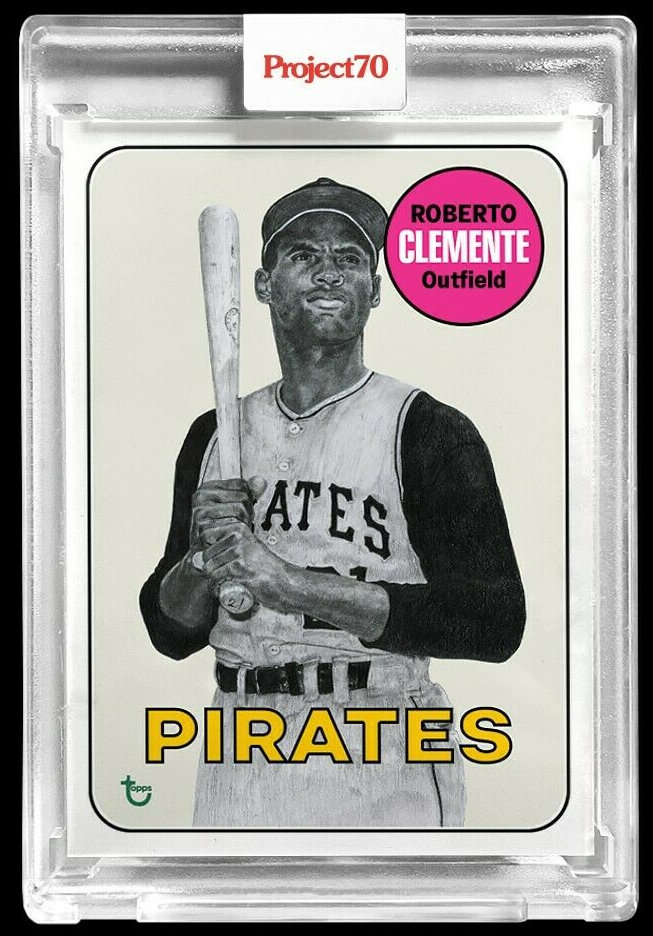

Does that make me part of the "woke" politically correct crowd?  I honestly don't care.  Those type of labels mean nothing to me personally.  I think we should treat all people with dignity and respect.  If they are offended by something you say, do your best not to offend them.  Especially something small like a name.  Whether we're talking about "Bob" Clemente, "Richie" Allen, the Washington Redskins or the Cleveland Indians.  Most times it costs you nothing.  Other times it could be a marketing bonanza.  Just think how many new jerseys, t-shirts, hats, etc. the Guardians will sell this year. 


I have been collecting cards since 1974.  By then Clemente was gone, but I had never heard him referred to as "Bob".  It was odd when I found older cards that had that name.  By 1970 even Topps was calling him Roberto.  For me to refer to him as "Bob" in an effort to be historically accurate to what Topps would have done, is counter to what I put at the very top of this blog.  "What cards would look like if I had my way".  So with my apologies to Roberto Enrique Clemente Walker, here is the card I should have made:


I think it looks just as good as my previous "Bob" Clemente card. And it cost me nothing to show simple respect.


Thursday, November 1, 2018

Stretch

Willie McCovey
1938-2018


Yesterday we lost another legend. Willie "Stretch" McCovey.  I put together one more 1972 Alt-Topps card in his honor. Additionally, I have included all of the cards I've made of McCovey over the years for this blog. 


Monday, April 10, 2017

Even More For 1963 Fleer

In my previous post I pointed out some other types of cards that might have been included in the 1963 Fleer set had it not been cut short due to Topps' lawsuit. In my last post I added manager, rookie and team cards. But what set would be complete without leader cards?

Again I made one example from the American League and one from the National. Not a bad selection of players either. Five out of six are in the Hall of Fame now.  I tried to remain true to the Fleer design, but when I was done it looks reminiscent of Topps 1964 Leader cards.

Also missing from the initial 66 cards were World Series cards. Not necessarily essential, but usually a source of action shots in the 1960's when most cards were posed. Again, one card example featuring the National League team, and one for the American League.

 I decided to go with black and white photos out of necessity. While I could find a few color photos of the 1962 Series. Topps colorized their WS cards in the early 60's but revered to black and white in the later part of the decade.

One of my favorite subsets, the All Star cards, were notably missing from the 1963 Topps set. When Topps did  include All Stars, they weren't often the starting All Stars from the previous season. Often they were labeled "Sporting News All Star" but often that wasn't the case either.

In my examples, both players were Sporting News All Stars in 1963.  Luis Aparicio played starting shortstop in the 1962 All Star Games while a member of the White Sox. In 1963 he was the backup to Zoilo Versalles . Johnny Edwards was the Sporting News All Star in 1963 but was a backup to Ed Bailey of the Giants in the 1963 All Star game. Edwards took over for Bailey as the Reds catcher in 1961 when Bailey was traded to the Giants. Edwards, a three time All Star and two time Gold Glove catcher was succeeded by Johnny Bench in 1968.

In the Original 66 cards was the rookie card of Maury Wills. On that card, instead of the usual player drawing, Fleer put "N.L. Most Valuable Player '62". They replicated that for their 1998 Mickey Mantle insert card. I made a Rookie of the Year card for Ken Hubbs using the same design.

While most sets of this era didn't have "Award" cards, it seem like a logical extension. So here is the other R.O.Y. from 1962, Tom Tresh and the 1962 Cy Young Award winner, Don Drysdale.


Tuesday, April 4, 2017

1963 Fleer Extended Set

In my last post, I wrote about the 1963 Fleer set. Specifically, how it was just 66 base cards and not a complete baseball card set as we know it. So today I am speculating about what some of the other non- base cards would look.

One of the first omissions from the set is the manager card. Johnny Pesky guided the Red Sox in 1963 and 1964. Hand picked by Tom Yawkey, Pesky was a fan favorite. But the Sox finished in 7th in 1963 and 8th in 1964.

Harry Craft was the first skipper of the expansion Colt .45s in 1962. He coached there until his eventual dismissal late in the 1964 season. The Colts weren't the first team he'd managed. He was the K.C. Athletics manager from 1957-59 and was part of the Cubs "College of Coaches" experiment in 1961. In his 7 years managing 3 different clubs, he never finished above 7th place.

Since there wasn't a player pose for manager, I had to create one. With the help of photoshop, I lifted the outline of Casey Stengel striking a classic pose.

You know what else is missing? Good old-fashioned team cards. They are missing from current sets as well. I guess they just don't take those type of pictures anymore. Too bad, I miss them.

I picked a team from each league. The Angels in just their 3rd year and the Pirates, who had been around since the late 1800s. I was surprised to learn that the Pirates logo from this era was this cartoonish buccaneer. Topps continued to use their older "classic" logo.

Last but not least are the rookie cards. Topps used the phrase "Rookie Stars" on their cards. Fleer sets of the 80s used the term "Prospect" which seem more appropriate given some of the "stars" that appeared on Topps rookie cards.

I used the eventual 1963 Rookies of the Year as the subjects of these cards. In all they are all very good but only one was an eventual Hall of Famer. Dave DeBusschere is in the Basketball  Hall of Fame.

Friday, March 31, 2017

1963 Fleer

The 1963 Fleer set was cut short at just 66 cards. Topps won a court battle allowing it to have a near monopoly on baseball cards until 1981. Fleer had to cease printing cards after just one series. 

The '63 Fleer set has had loads of Cards That Never Were posted by multiple sources on the interwebs. I made nine different cards myself, which I posted on this blog and on my other blog, Rating The Rookies.  

Here are my 1963 Fleer cards of Ernie Banks, Ken Hubbs, Fritz Ackley, Curt Flood, Joe Shipley, Al Moran, Lee Stange, Don Zimmer and even Kris Kringle. 


Fleer themselves have made versions of these cards, too. They included this Mickey Mantle MVP card as an insert in its 1998 Tradition set.


Then again for its 40th anniversary in 2003 it included several very nice looking cards. Like these of Luis Aparicio, Lou Brock and Duke Snider::


Although the 2003 set included several players from 1963 it was annoyingly flawed. First, they changed the design slightly by shrinking the player sketch and coloring it white. Second was the inevitable Fleer Tradition logo on the top. But the biggest flaws were the players either in the wrong era uniforms, like Red Schoendienst and Willie Stargell,


 Or simply in black and white like Eddie Mathews and Frank Malzone:


***********************************************

Ok, all that was a long-winded prelude to tease my next few posts. I am not going to try to complete the 1963 set. That would be insane (although possibly fun).  

 We've seen plenty of base/player cards that never were based on the 1963 Fleer set. But if it had expanded beyond the first 66 base cards into an entire set, what would the other elements of a complete set look like?