Last week baseball lost another legend. Here is one more card in the style of the 1967 Alt-Topps. Over the past several years he has been featured on this blog more than a few times. In fact, he was even included in my latest posts of the 1967 Alt-Topps. He was on the AL batting leaders card.
He passed away on the 6th of April and his #6 was retired by Detroit in 1980. I thought it might be interesting to see how Kaline performed on April 6th over his Hall of Fame career. But what I came to realize is that the baseball season for the most part used to begin mid-April. Its has been creeping earlier and earlier since 1970. Kaling had only played on April 6th 3 times in his career. Collectively, he hit .462 in just 3 games: 1970, 1971 and 1974. He went 6 for 13 with 3 walks, 2 RBIs and 2 runs scored. Not bad.
Here are the cards that I've created for this blog in the past:
The 1989 ASG was played under the "Big A" in Anaheim. Once again neither Honorary Captain had ties to the host team.
The AL Captain was newly minted Hall of Famer Carl Yastrzemski. The 1989 class consisted of two first-ballot superstars, Johnny Bench and Carl Yastrzemski. The veteran's committee also selected Red Schoendienst and umpire Al Barlik. Yaz's stats read the way you would expect of a first-ballot HOFer; Triple Crown winner, AL MVP, All Star Game MVP, 18 All Star Games, 7 Gold Gloves. But there was controversy too. Yaz was accused of a lack of hustle when he thought the play or game wasn't important. This led to a much publicized rift that may or may not have caused the Sox to trade Tony Conigliaro to the Angels.
The NL Captain was Dodgers great Don Drysdale. Had he not been forced into early retirement (age 32) due to shoulder soreness, Drysdale might have been a first-ballot HOFer, too. He was an imposing pitcher at 6'5" and he had a 2 for 1 rule: "If one of my teammates got knocked down, then I knocked down two on the other team”. His stats bore that out. In his 14 season career, he was in the top-ten of Hit-By-Pitch 12 times. If you are wondering if this was intentional or not, he also finished in the top-ten for strikeout to walk ratio 10 times in 14 years.
Here are the Topps versions of the Captains Cards that appeared as inserts in the 1990 set.
Continuing with my revived All Star Break Tradition, the Honorary Captains. Spoiler alert: this is in no way as exciting as last night's duel between Guerrero and Pederson.
In 1988 the game was played in Cincinnati. Often there's one or more players with ties to the host team. If there's a connection here, I'm missing it.
The AL Captain was Bobby Doerr. He spent his entire MLB career with the Red Sox. Missing only the 1945 season to serve in the Army, he played from 1937-1951. Doerrwas a 9 time All Star who played in the shadow of Teddy Ballgame in his prime. It took the Veteran's Committee to induct him in 1986.
In the NL was first-ballot 1988 inductee, Willie Stargell. Pops was a seven time All Star. In 1979 he won the NL MVP, the NLCS MVP and the World Series MVP.
Again, the honorary captains appeared on the All Star Glossy inserts in 1989 Topps rack packs.
Before we even start, I admit that I cheated. I like the 1986 Topps set but absolutely hate the All Star cards in that set. So for my Honorary Captains series I took some of the elements of the 1986 All Star cards and used them to make a more consistent looking subset of the 1986 Topps set.
Less than a year after hanging up his cleats, Rusty Staub was named Honorary Captain of the NL. The All Star game was held at the Astrodome in Houston where Staub got his start. He was signed by the expansion Colt .45s in 1961 and played in Houston until he was traded to another expansion team, the Expos, in 1969. Rusty is the only MLB player to have over 500 hits with four different teams; Colt .45s/Astros, Expos, Mets and Tigers. The Expos retired his number 10 in 1993. Montreal's retired numbers did not travel with the franchise to Washington. The Montreal Canadiens righted this wrong by hanging his number along with the numbers of Gary Carter, Andre Dawson and Tim Raines in the rafters of the Bell Centre.
Charlie Gehringer was the honorary captain of the American League. Gehringer was the starting second baseman in the the very first All Star game in 1933 (30 years before Staub's MLB debut). In fact he was the starting second baseman in the first six All Star games. He was the 1937 AL MVP but his best year was in 1929. A year in which there was no AL MVP (or equivalent) award and was before the inception of the All Star game.He led the league in hits, doubles, triples, runs and stolen bases. He played all of his 19 seasons with Detroit. His number 2 along with Hank Greenberg's number 5 were the first to be retired by the Tigers in 1983.
After winning just one All Star Game out of the twenty played from 1963-1982, The American League won their second in the last four games 1983-86. The tides were turning.
Just as it was in the 1985 game, the starting pitcher won the MVP. In 1985 it was LaMarr Hoyt, in 1986 it was Roger Clemens who got the start, the win and the MVP. He pitch not just three scoreless innings but three perfect innings. The NL's starting pitcher Dwight Gooden got the loss and Orioles close Don Aase got the save. Lou Whitaker hit a two run homer in the second inning to put the AL ahead 2-0. Frank White added a needed insurance run with a solo shot in the 7th. The NL rallied scoring two runs off of Charlie Hough in the 8th but fell short losing 3-2.
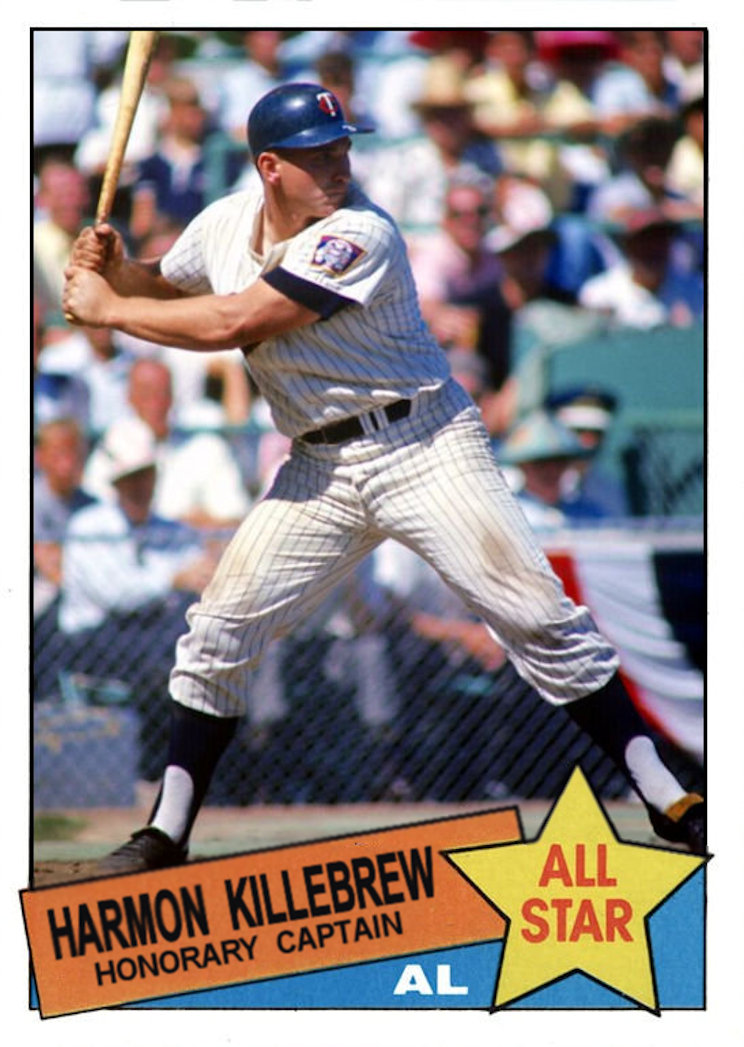
The 1985 All Star Game was a reunion of sorts for Honorary Captains Sandy Koufax and Harmon Killebrew. The two faced each other 20 years earlier in the 1965 World Series. Both players also competed in the 1965 All Star Game but didn't face each other. Killebrew hit a 2 run homer but Koufax got the win. The NL won 6-5 in the old Metropolitan Stadium in Minneapolis.
In the 1965 World Series, the home team won the first six games. The Twins got the first two in Minneapolis with Koufax losing Game 2 to Jim Kaat. The next three in L.A. would all go to the Dodgers. Koufax pitched a two-hit shutout in Game 5 again facing Twins lefty Kaat. One of the two hits given up by Koufax was a single by Killebrew. Game 6 returned to Metropolitan Stadium as the Twins evened the series at three. For Game 7 both teams went with their lefties despite only having two days rest. Koufax out-dueled Kaat again. After Kaat gave up the only two runs the Dodgers needed in the 4th he was pulled. Koufax went the distance again pitching a three hit shutout. Once again one of those hits belonged to Killebrew, but the World Series Championship and the MVP belonged to Koufax.
The 1985 All Star Game was in Minneapolis again after 20 years. In 1965 it was in Metropolitan Stadium but in 1985 it was in the Metrodome. Padres pitcher LaMarr Hoyt got the start, the win and the MVP on the strength of three scoreless innings. Despite being nicknamed the "Homerdome" the game went without the long-ball. All tolled there were 14 hits by 14 different players as the NL cruised to a 6-1 victory.
It's the All Star break and I get to add to my collection of Honorary Captains.
The 1984 All Star Game was played in Candlestick Park and representing the National League was hometown hero Willie McCovey. A first ballot Hall of Famer in 1986, Stretch's resume is extensive: Rookie of the Year in 1959, NL MVP in 1969, All Star Game MVP in 1969, six time All Star, and the list goes on. He was the 12th player in MLB history to hit 500 home runs. He was only the second after Ted Williams to hit homers in four decades. Not only did the Giants retire his number 44 but when the new ballpark was built they renamed China Basin to "McCovey Cove" which is just outside the right field wall.
Representing the American League was Hank Greenberg. Elected to the Hall of Fame in 1956, the career stats don't tell the whole story of this two time MVP. He was originally classified 4F in the draft for supposed "flat feet". He requested to be re-examined and was drafted into service in 1941 and received an honorable discharge just 2 days before the bombing of Pearl Harbor. He re-enlisted and served until June of 1945. Overall he served 47 months, the longest of any Major Leaguer. He missed all of the 1942,43 and 44 seasons, and most of 1941 and 1945. When he returned for the latter part of the 1945 season he hit .311 and in 1946 he led the League with 44 homers and 127 RBIs. Who knows what numbers he could have put up with the addition of over 4 seasons added to the prime of his MLB career.
The 1984 All Star game itself was won by the NL 3-1. Three of the four runs scored were from solo home runs by Dale Murphy, George Brett and the All Star Game MVP Gary Carter. The win went to Expos pitcher Charlie Lea. Rich Gossage of the Padres got the save. The loss went to former Southern Illinois Saluki, Dave Stieb of the Blue Jays.
Last night the American League won their 3rd straight All Star Game. In 1983 the AL had won their first ASG after losing 11 straight. The game was at Comiskey Park in Chicago. It was the 50th anniversary of the original ASG which was part of the Chicago Worlds Fair.
The National League's honorary captain was Ernie Banks. Although the game was played on the south side, Ernie's name is synonymous with Chicago baseball. He played his entire 19 season career in a Cubs uniform. An All Star 14 times and a back to back NL MVP (1958 & 1959), "Mr. Cub" was a first ballot Hall of Famer in 1977.
Joe Cronin was chosen as the AL's honorary captain. Cronin was the starting shortstop for the American League in the first ever All Star game. Back then he was a member of the Washington Senators. He went 1 for 3 with a walk and a run scored. The AL won 4-1. Cronin was runner up for the AL MVP in 1933 finishing behind fellow Hall of Famer, Jimmie Foxx.
In 1933 Cronin was in his first year acting as player/ manager of the Senators. The following year he would manage and play shortstop in the 1934 All Star Game. The Red Sox traded for Cronin after the 1934 season. They gave up their starting shortstop, Lyn Lary and $225,000 (roughly $4 million in today's dollars). Cronin would serve as player manager of the Sox for 11 years and just manager for 2 more. In 1956 he was inducted into the Hall of Fame.
***
About the game: A former Southern Illinois University "Saluki", Dave Stieb was the starting pitcher. He pitched 3 inning of no-hit ball. But he gave up an unearned run on 2 errors to the game's first 2 hitters. Both were grounders to the pitcher. The first was an error on Stieb's throw to first. The second was on first baseman Rod Carew's catch. After spotting the Nationals a one run lead, Stieb was lights-out. He retire 9 of the next ten hitters, striking out 4 and allowing only one baserunner on a walk to Al Oliver.
MVP honors went to Fred Lynn of the Angels. Lynn belted a Grand Slam as part of the AL's 7 run 3rd inning. Atlee Hammaker, in his only All Star appearance gave up 3 singles, a triple, an intentional walk and 2 homers including Lynn's slam. The final score was 13-3 with the decisions going to both starting pitchers. Steib got the win and Mario Soto got the loss.
About the cards: In 1982 Topps went back to having separate all star cards rather than incorporating an all star designation on their regular issue cards. I struggled with whether to use regular issue cards or use the All Star cards from that years set. I actually think the 1983 AS cards are decent looking but the regular issue cards are much nicer. And as we move further into the '80s the divide only gets worse. If anybody that reads this far down into the text has an opinion on this subject, please leave a comment. Hopefully, I will still be blogging by the next All Star break and I am really undecided on how to proceed, but we have plenty of time.
About the photos: Normally, I use photo's from the playing days, but Cronin retired from playing and managing in 1947 so I could not find a decent color photo. I did find this picture of him wearing a mid '70 era Red Sox uniform. I'm not sure what the occasion for this was.
At the '83 All Star Game he was looking good in a vintage Washington Senators uni. It doesn't look exactly authentic for the era (no pinstripes and the '60s era curly "W"), but it was a nice looking throwback uni anyway and I wish I could have found a decent photo of it to use on his card. But since I didn't here is a video I found on Youtube. It is the AL introductions for the All Star game. At the end Banks an Cronin come out.
Banks is also wearing an inaccurate uniform. He never had his name on the back of a home uniform during his playing days. In fact the Cubs didn't have names on the backs of their home jerseys until 1993. Ten years after Banks appeared in this video with his name on the back of his jersey.
Tonight is the All Star game, so as part of my annual ritual, here are some more Honorary captains. These are the 1982 captains. For the first time since 1974, Topps had separate cards for the All Stars. The 1975-1981 sets had an All Star design incorporated into the regular issue cards of the players.
For the first time in MLB history, the 1982 All Star Game was played outside the United States.The Montreal Expos hosted the event in Olympic Stadium. The Captain of the National League was Duke Snider. Snider played briefly for the Montreal Royals in the 1940's before being called up to the Brooklyn Dodgers. The 8 time All Star centerfielder was inducted into the Hall of Fame in 1980.
Yogi Berra was the AL honorary captain as well as a member of the Yankees coaching staff in 1982. A 3 time MVP and 18 time All Star catcher, Yogi had 10 World Series rings as a player and 3 more as a coach. I'm not sure which is the bigger travesty; that the writers took 11 votes before inducting Duke Snider into the Hall or that it took them 2 to induct Yogi.
The AL jumped out to an early 1-0 lead in the top of the first inning of the 1982 All Star Game. Lead-off -man-extraordinaire Rickey Henderson scored on a Reggie Jackson sac-fly. After that it was lights out. The Nationals took the lead on MVP Dave Concepcion's 2 run homer in the bottom of the 2nd inning and the NL won the game 4-1. This was the NL's 11th straight All Star victory.
The All Star break in upon us once again. So here a few additions to my All Star Game Honorary Captain collection.
Warren Spahn represented the National League as Honorary Captain in the 1981 All Star Game. Spahn's heroics on the field earned him 17 All Star appearances and 13 20-win seasons, He led the league in ERA 3 times, strikeouts 4 times, shutouts 4 times, victories 8 times and complete games 7 times. He earned The Sporting News Pitcher of the Year Award 4 times, The Cy Young award in 1957 and The Lou Gehrig Award in 1961. In 1973 he was voted into the Hall of Fame.
The hometown hero, Bob Feller represented the American League as honorary captain at the 1981 All Star game in Cleveland. Feller was a triple crown winner in 1940, leading the league with a 2.61 ERA, 27 wins and 261 strike outs. He was an 8 time All Star and led the league in victories 6 times and in strikeouts 7 times. He had 3 career No-Nos and was inducted into the Hall of Fame in 1962.
It is worth noting that both of these pitchers left the comfort of the MLB to join the armed forces in their prime. Feller was the reigning pitching champion, having led the league in victories 3 consecutive years leading up to his 3+ years serving as an anti-aircraft gunner chief aboard the USS Alabama. In his first full season back he led the league again and was selected to the AL All Stars.
Although Spahn was a rookie before serving, in his first full season back he led the league in ERA and was selected to the NL All Star Team. Spahn's military career held nearly as many awards as his baseball career. He was a combat engineer who fought in the "Battle of the Bulge". He received a Purple Heart after taking shrapnel to his foot. His unit was awarded the Distinguished Unit Emblem and he received a battlefield commission to second lieutenant.
As for the game itself, this would be the 4th and final time the game would be held at Cleveland's Municipal Stadium. The game was rescheduled to August 9th because of the baseball strike. It still holds the attendance record for All Star games with 72,086 and the most players used with 56. The NL won 5-4 with all of its runs scored via the long ball. Gary Carter had 2 solo homers and was named MVP. Dave Parker also soloed and Mike Schmidt had a 2 run homer to give the NL the victory.
Rounding out my 2014 All Star Break set are the Honorary Captains of the 1980 All Star game in Los Angeles.
Representing the National League was 1969 Hall of Fame inductee and Dodgers fan favorite, Roy Campanella. Campanella appeared on one of the earliest "Card That Never Were" I am aware of, when Topps put him on a 1951 card as part of the 1975 MVP subset. A three-time MVP, Topps would also have to create a 1955 card of him (as well as a 1962 Maury Wills card).
Representing the 1980 American League All Stars in was 1980 Hall of Fame inductee Al Kaline. Kaline was a first ballot Hall of Famer with over 88% of the vote. He was also the youngest player to win the batting title in 1955. Signed by the Tigers in 1953, Kaline spent all 22 MLB seasons in Detroit. He retired at the end of the 1974 season just 1 homer shy of the 400 mark.
In honor of tonight's All Star Game here is another posting of past Honorary Captains.
35 years ago the All Star Game was held in the Kingdome in Seattle. The Honorary Captains were both Hall of Fame pitchers who appeaerd in the very first All Star game at Comiskey Park. The game was conceived as part of the 1933 Worlds Fair in Chicago and has been an annual affair ever since.
In that first game Hubbell pitched the final 2 scoreless innings in relief. He surrendered a a walk to Lou Gehrig and a single to Jimmy Dykes.
The American League's Honorary Captain was the starting pitcher in the 1933 All Star game. He pitched 3 scoreless innings and was credited with the win. The American League won the 1933 All Star game 4-2 in 1933 but lost the 1979 All Star game to the Nationals on a bases loaded walk to Lee Mazzilli in the top of the 9th.
It's the All Star break and time to add to my collection of All Star Game Honorary Captains.
In 1978 Eddie Mathews was inducted into the Hall of Fame. He was also selected to represent the National League as Honorary Captain at the 1978 All Star game in San Diego. Mathews was the only player to play for the Braves in Boston, Milwaukee and Atlanta and hit 493 of his 512 home runs in a Braves uniform.
The American League Honorary Captain was Brooks Robinson. "The Human Vacuum" had just hung up his cleats following the 1977 season. Robinson was a first ballot Hall of Famer with 92% of the vote in 1983.
In 1977 the All Star Game was held in New York. and both Honorary Captains represented New York Teams.
1977 Topps Willie Mays All Star
Although Mays could have represented the San Francisco Giants, he donned his Mets uniform for the occasion. After all, he did begin and end his career in New York.
1977 Topps Joe Dimaggio All Star
Representing the American League was the Yankee Clipper himself, Joe Dimaggio.
I am kind of sorry to see the end of the All Star break. I will definitely get back to making more of these cards. I'm not sure I will have the patience to wait until the next All Star break.
To get myself in the mood for tonight's All Star Game here are 2 more Honorary Captains from the 1976 Midsummer Classic:
1976 Topps Robin Roberts All Star
Coinciding with the Bicentennial Celebration, the All Star Game was played in the city where the Declaration of Independence was signed, Philadelphia. Hometown hero, Robin Roberts was elected to the class of 1976 Hall of Fame and was made Honorary Captain of the N.L. Team.
1976 Topps Bob Lemon All Star
Bob Lemon was also voted into the Hall of Fame in 1976 and he Captained the A.L. All Stars.
With the All Star break upon us I thought I would make a few cards to honor the occasion.
1975 Topps Stan Musial All-Star
The practice of selecting an Honorary Captain of the All Star Team began in 1975. It continued until 2003. In 2007 once again Honorary Captains were named but the practice was abandoned the following year.
1975 Topps Mickey Mantle All-Star
In 1975 the Honorary Captions were Mickey Mantle and Stan Musial. The game was played in County Stadium in Milwaukee. Milwaukee was home to the American League Brewers and the former home to the National League Braves. In theory they could have chosen some hometown favorites to honor but instead went with 2 living legends.