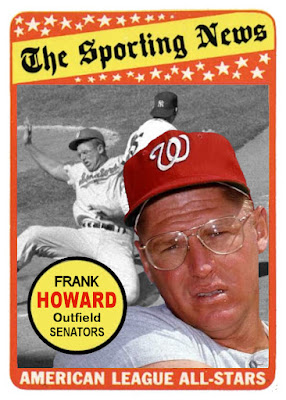
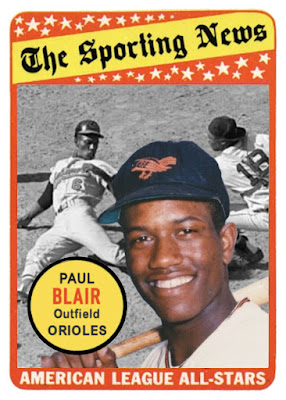
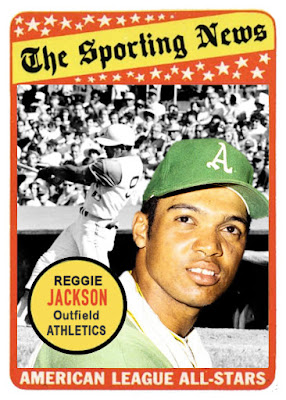
Who probably didn't merit inclusion in the 1969 Topps All-Star set, but was in it anyway?
Tony Oliva
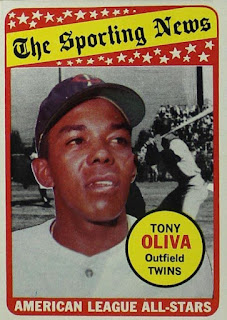
Who probably didn't merit inclusion in the 1969 Topps All-Star set, but was in it anyway?
Tony Oliva


 For the All-Star cards, I decided to take another rejected Topps card. This one may have been meant for a booklet cover or something similar. Although it says Willie McCovey, he is obviously absent from either photo.


 I went back to following Topps script with the design of the leaders card. I also followed their lead by using "Bob" and "Richie" instead of their preferred names: Roberto Clemente and Dick Allen. Leading the NL in RBIs in 1966 was the "Hammer", Hank Aaron.
 For the AL, I simply had to include the "Judge". 1966 was his Triple Crown year. Here we have all 3 batting average leaders, Robinson, Oliva and Kaline. Not a bad leaders selection. It contains both 1964 Rookies of the Year and 4 Hall of Famers.
 Finally, for the World Series card, I used another Topps reject. The mock-up says Tom Siever (another inside joke?). I can't make out any of the black and white players on this card but that sure looks like Drysdale on the inset. On my version, I kept the rounded corners with the little flourish and added a border for continuity. I also added the 1966 World Series logo to the card.
  Instead of a black and white inset with a blue background, I used a color head-shot. It seems as though the Dodgers offense took the Series off. They managed only 2 runs in the first game then went scoreless in the next three. The O's outscored them 13-2 in a four game sweep.
 The manager cards in the actual 1964 Topps set were pretty much the same as the base cards. In my "Bizzaro Universe" set, too.
 For the team cards I kept the basic card design continuity along with the full color team logo.
 In the real 1964 Topps set, the picture for the A's showed a team still in the 1961 uniforms. In the early 60's the A's changes uniforms more than most teams changed underwear. The uniforms shown on this card were introduced in 1964.
  For the rookie cards I went 3 across and broke it down to position and league. This is something that I don't think Topps ever did. I've seen them break it down by league, team, or position. To my best recollection, I don't remember Topps going in this direction. They only had multiplayer rookie cards since 1962. In 62 they were broken down by position. In 1963 they were simply labeled "Rookie Stars", not broken down by league, team nor position. So it's not too far fetched that this would be the format they could've opted for,
 Of course with 20/20 hindsight, I stacked the deck with the Rookies of the Year for 1964, Dick Allen and Tony Oliva. I also doubled up on rookie Hortons in the AL. In the NL included Don Kessinger and HOFer Tony Perez.


