It's funny looking at the Topps football cards and seeing hints of what's in store for future Topps baseball cards. These 1958 football cards hint at the 1959 baseball card design. Here is the 1958 Topps rookie card of Eagles/Redskins Hall of Fame QB Sonny Jurgensen side by side with 1958 NL MVP "Mr. Cub", Ernie Banks.
Showing posts with label Rookie Card. Show all posts
Wednesday, July 14, 2021
Monday, March 15, 2021
Barrier Breakers: 1955 Elston Howard - New York Yankees
My final Barrier-Breaker card is a 1955 Topps Elston Howard of the Yankees. He debuted in April of 1955 and played for the Yankees from 1955-1967 when he was traded to the Red Sox. He finished his career in Boston in 1968. He was a twelve-time all star and the 1963 AL MVP. He did have a Bowman card in 1955 but not a Topps card. Oddly, he also had a card in the 1994 Topps Archives set depicting him as a "1954 Prospect". But to my knowledge, this is the only 1955 Topps card of Elston Howard.
He had been in the Yankees system since 1950 after they purchased him from the Kansas City Monarchs. When he came up with the Yankees, he spent most of his time in the outfield. Future Hall of Famer and three-time MVP, Yogi Berra caught most games with the Yanks until 1960. Howard took over and earned Gold Gloves behind the plate in 1963 and 1964.
Thursday, March 11, 2021
Barrier Breakers: 1951 Minnie Minoso - Chicago White Sox
Although Orestes "Minnie" Minoso broke the color line for the White Sox in 1951, he made his MLB debut on the Indians in April of 1949. He hit .188 in 20 plate appearances with 2 walks and 2 hit-by-pitch. He spent the rest of '49 and '50 in San Diego of the PCL hitting .297 and .339 respectively. That earned him a short-lived promotion to the Indians in 1951. It was short-lived because he was dealt to the South-Siders in a six-player, three-team swap. Once on the Sox, he batted .324 with 10 homers and 74 RBIs. He also led the league with 31 stolen bases and 14 triples, was 4th in MVP voting and second in Rookie of the Year voting.
Minnie is a favorite of mine and has been featured on this blog several times. This 1951 Bowman first appeared here in August of 2011. I also made a 1951 Topps card for him as an Indian.
I've made several cards of the Cuban Comet over the years, but wanted to find another to make for this post. I settled on a 1965 "Career Capper". I considered a 1963 Fleer card featuring him on the Senators because he doesn't have a card in a Washington uniform. But decided that this post was about the White Sox. That'll be a project for another day.
Saturday, March 6, 2021
Barrier Breakers: 1954 Carlos Paula - Washington Senators
Carlos Paula was the first Black player on the Senators. Born in Cuba, he was signed by Washington and invited to spring training. Although he was praised for his arm, his speed and his hitting, manager Bucky Harris thought he had a "hitch in his swing" and needed more time in the minors. He batted .309 with 14 homers for the Charlette Hornets and the Senators promoted him on September 6th, 1954. In 1955 he was their everyday right fielder hitting .299.
Although Paula was the first black player on the Senators, there were 24 other Cuban players on the team between 1935 and 1954. In 1955 three more black players joined the roster in DC. Two were Cubans, Juan Delis and Julio Becquer, and one was Panamanian, "Webbo" Clarke. It wasn't until 1957 when the Senators signed the 1952 Rookie of the Year, Joe Black, that a US born African American joined the team. (I made this 1957 Joe Black card nearly ten years ago for this blog.)
Monday, March 1, 2021
Barrier Breakers: 1959 Pumpsie Green - Boston Red Sox
Twelve years, three months and six days after Jackie Robinson made his debut with the Dodgers, the Red Sox begrudgingly became the last MLB team to integrate. Only under the ongoing investigation and charges of violating Massachusetts's Fair Employment Law, did the Sox relent. Pinky Higgins the Red Sox manager was quoted as saying "There’ll be no n* on this ball club as long as I have anything to say about it.” He was replaced by Billy Jurges exactly 2 weeks before Green was called up.
Enough about Yawkey's Red Sox and what was referred to at the time as "Aryan Acres" and more about Pumpsie Green. He platooned as a middle infielder his whole career. He batted an adequate .246. He played pro ball from 1951-1965. But his MLB career was just from 1959-1963. He was named to Topps Rookie All-Star team in 1959. He appeared on Topps cards from 1960-1964.
I have chosen to depict him on a 1959 Rookie Stars card. In 2008 Topps gave him a 1959 style insert as part of that season's Heritage issue. Although his career stats don't bear it out, his accomplishments and sacrifices has endeared him to fans everywhere.
Thursday, February 25, 2021
Barrier Breakers: 1954 Nino Escalera - Cincinnati Redlegs
The Reds (or Redlegs as they were called at the time) were the second to last NL team to integrate. On April 17, 1954 they debuted two black players. Nino Escalera and Chuck Harmon, Nino pinch hit to lead off the 7th inning with a single. The very next batter was Chuck Harmon, also pinch hitting. He popped out.
Nino hit a meager .159 in 1954 then returned to the minors until retiring in 1962. The player that was one at-bat later, and the second black player on the Reds, hit a mildly better .238. Chuck Harmon would play for the Redlegs, Cardinals and Phillies until 1957. He never rose above a utility player but did have a somewhat better career than Escalera. He also had Topps cards in 1954, 55, 56, 57 and 58. Nino never had a card.
Allegedly, it was manager Rogers Hornsby that didn't want black players on the team. The Hall of Famer managed the Reds in 1952 and 53. I understand that Hornsby's views were not far from the norm of that era. But by 1952, he hadn't managed a team above a 6th place finish in 20 years. I had always felt the front office in Cincinnati was cowardly for believing that keeping Reds moniker would somehow confuse people into thinking they communist sympathizers. My opinion of that era's management is even lower for allowing their manager's racial bias cloud his decision making.
On a more positive note, by 1956, Cincinnati had more African American players than any other Major League team with 8.
Tuesday, February 23, 2021
Barrier Breakers: 1954 Curt Roberts - Pittsburgh Pirates
Curt Roberts played professional ball from 1947-1963. He began as a shortstop for the Kansas City Monarchs. He was signed by the Braves in 1951. In 1952 he was signed by the Pirates General manager Branch Rickey. He was promoted to the Big Leagues at the beginning of the 1954 season and became their everyday second baseman and the first African American on the Bucs. After struggling in 1955 he was sent down to the minors. He reclaimed his job in 1956 only to lose it to future Hall of Famer Bill Mazeroski.
In June of '56 he was traded to the A's as part of a three-player deal. Prior to the 1957 season he was dealt again to the Yankees as part of an eleven player swap. In all he played minor league ball for six different franchises; Braves, Pirates, A's, Yankees, Dodgers and White Sox, but he never made it back to the Majors after the 1956 season.
Friday, February 19, 2021
Barrier Breakers: John Kennedy, Philadelphia Phillies
It's been a while since I posted to this series. The truth is I was hoping to find a better photo to use. As it is, I colorized this black and white photo of John Kennedy and superimposed him into Connie Mack Stadium. I'm not really happy with the final product but at some point I need to quit tinkering and move on.
Although John Kennedy broke the color barrier with the Phillies, his career was brief. He played in just five MLB games. Three times he came in as a pinch runner, twice as a defensive replacement late in the game. In all he had just two plate appearances. He struck out and grounded out. The first black player to register a base hit with the Phillies was Tony Curry in 1960.
It is odd that the Phillies were so late to integrate. It may have been quite a bit different. I had posted earlier about Bill Veeck who claimed in his 1961 autobiography that he tried to buy the Phillies in 1943. He claimed his plan was to populate the team with top negro league players. Click Here to see that old post.
Because his career with the Phillies was so short, it was difficult to find a suitable photo. If anybody can find a better photo, I'd love to have a do-over.
Wednesday, May 29, 2019
Bill Buckner 1971 Alt -Topps
1949-2019
Another 1971 Alt Topps for Bill Buckner. We lost him this past Memorial Day. On that day, 9 different players did something Buckner never did in his entire MLB career.
On the day that Bill Buckner passed away Niko Goodrum, Jim Adduci, Dainiel Descalso, Jonathan Schoop, CJ Cron, Miguel Sano, Matt Olson, Shin-Soo Choo and Mitch Haniger all struck out 3 times in a single MLB game. In his 22 year career, Bill Buckner never had a 3-strikeout game.
Buckner led the league 4 times in At Bats per strikeout. He finished in the top 10 eleven times. Over his career he averaged 20.7 at bats for every strikeout. Just to put that in context, the current MLB leader in strikeouts per at bat is the Angels second baseman, David Fletcher with 13.8.
He had been featured on Rookie Stars cards by Topps in both 1970 and 1971. He finally had hid own Topps card in 1972. Thursday, July 21, 2016
TBT - Baltimore Orioles Edition
On the Friday before the All Star break, the Orioles celebrated the 50th anniversary of their 1966 World Series championship. The team sported the same unis as their 1966 counterparts. Their opponents, the L.A. Angels didn't play along and just wore their everyday 2016 away uniforms.
The differences in the 1966 and 2016 uniforms are not dramatic. The main differences being the Orioles script on the '66 uni is slightly different and not underscored and the 2016 caps have a white field behind the cartoon bird. I chose to compare a picture of 2016 shortstop Jonathan Schoop turning a double-play with 1966 second baseman Davey Johnson doing the same. While looking for a Topps card that showed the Orioles home uniforms of this era, I came up short. Perhaps I should say Topps came up short. Although the Orioles uniforms changed in 1966 most cards from 1966-1970 showed home uniforms from 1965 or older or showed the away uniform.
Rather than use a card from the early seventies to compare the uniforms, I made two Card That Never Were for this post. Davey Johnson was an obvious choice. Topps had included him on a "Rookie Stars" card in the 1965 set, the year in which he made his MLB debut. In 1966 Johnson had earned a starting role as second baseman for the World Series Champs and even a Rookie of the Year nomination. But he didn't earn his own Topps card. Instead he was put on a second, late series "Rookie Stars" card in 1966. So here is a second year card of Davey Johnson that would never have appeared in a 1966 Topps set. It is an action shot of him actually wearing a current uniform.Saturday, May 7, 2016
1965 Philadelphia Gale Sayers
1965 NFL Rookie of the Year
For the first and only time, both the NFL and AFL Rookies of the Year were future Hall of Famers. In the AFL was a brash young QB out of Alabama named Joe Namath. We've all seen his iconic rookie 1965 Tall-Boy, below. In the NFL was a a quiet running back out of Kansas, Gale Sayers. He wouldn't be seen on cardboard until the 1966 Philadelphia set in which he had 2 cards. He had a regular issue and was featured on an action card in that set.
Wednesday, July 29, 2015
1964 Philadelphia Charley Taylor
1964 NFL Rookie of the Year
In August of 1964 Charley Taylor was the MVP of the College All-Star game versus the NFL champion Chicago Bears. The All-Stars lost 28-17. Taylor, who is best known as a wide receiver for the Redskins, played halfback for Arizona State. Taylor figured in all 3 score for the All Stars. He made a leaping 29 yd reception to set up the field goal to give them the early 3-0 lead. He recovered a muffed punt by the Bears, then threw a touchdown pass to Colts draft pick, Ted Davis to regain the lead. In the second half he was on the receiving end of a touchdown pass from 49ers draft pick George Mira.
The entire 1964 Philadelphia NFL set had only 198 cards and Charley Taylor was not not included. After winning the Rookie of the Year, he would be included in all major issues from 1965-1976. He was selected to the Pro-Bowl 8 of his 13 NFL season. He was inducted into the Hall of Fame in 1984.
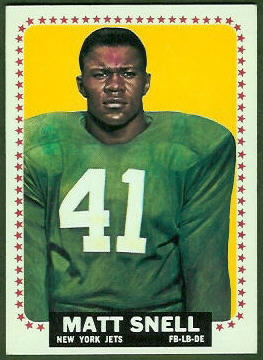
The AFL Rookie of the Year, Matt Snell was included in the 1964 Topps set. In 1964 Topps lost the license to make NFL cards and gained the rights to the AFL from Fleer. Snell was a 3 time AFL All-Star for the Jets, and rushed for the first touchdown in the Super Bowl III upset over Johnny Unitas and the Colts.
Friday, May 22, 2015
1968-69 O-Pee-Chee Bill Masterton
It has been a while since I made a hockey card for this site. Now we're deep into the Stanley Cup playoffs, so I think it's time.
Each year the NHL awards the Bill Masterton Memorial Trophy to the player "who best exemplifies the qualities of perseverance, sportsmanship and dedication to hockey". Most often the award is given to a player who has overcome a serious injury or illness.
Masterton played 3 years for the University of Denver winning the Frozen 4 Championships in 1960 and 1961. At the time he graduated he was the Pioneers all time leading scorer. He was signed by the Montreal Canadiens but during the original 6 era there was very little opportunity for a minor league player. In 1967 the NHL expanded to 12 teams and opportunity knocked. He was signed by the Minnesota North Stars.
Masterton played just 38 games that season. On January 13, 1968 he was checked at center ice. His head hit the ice knocking him out, bleeding from the ears, nose and mouth. He briefly regained consciousness but his head injuries were too severe. He died 30 hours later.
There have been several award cards bearing his name but Bill Masterton has never had a card of his own. Even though the league expanded to 12 teams in 1967-68 the hockey cards issued that year only featured Original 6 teams. In the 1968-69 set expansion teams like the North Stars had cards as well. But Topps and O-Pee-Chee never made a card for Masterton. I created this one for Bill Masterton and borrowed the "In Memoriam" banner from the 1964 Topps Ken Hubbs baseball card.
Monday, April 20, 2015
1967 Philadelphia Doug Buffone
1944-2015
The Chicago sports world lost another great Monday. Although he may not be recognized as a national figure, he was a legendary player in Chicago. Later he became a color commentator and sportscaster on many different television and radio shows over the years. Although he was never selected to the Pro Bowl, he held and continues to hold many Chicago Bear records. Including most sacks in a season with 18 in 1968 and most interceptions by a linebacker.
Buffone played only for the Bears. His NFL career began in 1966 and ran through 1979. As I was trying to choose an appropriate card to make for him, I realized how few cards he had. His "rookie" Topps card was in 1970 and his final card was in 1976, and even then he was skipped over in 1972 and 1973. In all, the 14-year-pro had only 5 major issue football cards. I may have to right this wrong in the coming days.
Sunday, April 5, 2015
1963 Fleer Billy Joe
Like the 1963 NFL Rookie of the Year, Paul Flatley, Billy Joe was drafted both by the NFL and AFL, In the 9th round by the Redskins and in the 11th round by the Broncos. In his AFL Rookie of the Year season, Billy Joe rushed for 646 yards and 4 touchdowns. He had another TD receiving along with 90 yards for a total of 736 all-purpose yards.
In 1965 he was traded to the Bills for Cookie Gilchrist. Billy Joe was selected to play in the AFL All Star Game and helped the Bills win their second consecutive AFL Championship. He played 7 years all in the AFL. In addition to the Broncos and Bills, he played for the Miami Dolphins and the New York Jets.
After his playing days he became a successful college football coach. In his 33 years coaching he won 243 games, second only to Grambling's Eddie Robinson among historically black colleges.
Thursday, April 2, 2015
1963 Topps Paul Flatley
Paul Flatley was drafted in 1963 by both the Denver Broncos in the AFL and the Minnesota Vikings of the NFL. The Northwestern receiver elected to remain in purple. He helped the Viking improve to a 5-8-1 record, their best finish in their 3 year history. He was voted Rookie of the Year in 1963 on the strength of 4 TDs and 867 receiving yards.
Flatley played 8 years in the NFL the first 5 in Minnesota and his final 3 for the Atlanta Falcons. The All-Pro receiver was fairly well represented on cardboard. He had Philadelphia cards from 1967-67 and Topps cards from 1968-70. But he didn't have a card for his rookie season. So here is his 1963 Topps rookie Card That Never Was. In the photo he seems to be contemplating the wisdom of choosing a single-bar facemask.
Friday, February 27, 2015
Rating the Rookies: 1960 Topps Ted Wieand
This time the random number generator came up with an early solo rookie card: this Ted Wieand card from the 1960 Topps set. Ted came up for a cup of coffee at the end of the 1958 season with the Reds (who were at the time called the Redlegs). The first batter he faced was Frank Torre (Joe Torre's older brother). Torre went yard on the rookie but Wieand regained his composure and retired 6 of the next hitters he faced in the 4th and 5th innings. In the bottom of the 6th he took the mound again only to give up a double to Hawk Taylor then a single to Frank Torre before getting sent to the showers.
When he was called back up at the beginning of the 1960 season he didn't fare much better. He appeared in 5 games, pitched 4 and 1/3 inning and gave up 5 runs. His final MLB game was just 10 games into the 1960 season. He came in with the Reds clinging to a 5-4 lead over the Phillies with runners on 2nd and 3rd, no outs. He intentionally walked the first batter to load the bases. He then walked the next batter, presumably unintentionally, to tie the game at 5. The next batter hit a grand slam. The Reds lost 9-5. Wieand returned to the minors and was dealt to the Yankees. He never made it back up to the Big Leagues.
I chose to make a 1958 card to commemorate his only other MLB appearance even though it was brief. As for his 1960 Rookie card I can understand why Topps chose to give him a card. He was the Reds winningest AAA pitcher in 1959 and was on the roster at the beginning of the Reds' 1960 season. However, Ted Wieand didn't even make it through April.
I've adopted a new grading system. Just like those pricey grading companies, I'll hermetically seal the card and permanently attach my (somewhat) unbiased opinion along with a grade from 1 to 10. Unlike the grading companies, my score has nothing to do with the condition of the card but the card itself.
Wednesday, February 18, 2015
1982 Fleer Major League Prospects: Ryne Sandberg, Wade Boggs
In 1982 there were 17 player who received Rookie of the Year votes. 11 of the 17 players made it onto cardboard in at least 1 of the 4 major releases, Topps, Topps Traded, Fleer and Donruss. In my last post I put 4 of the remaining 6 onto a multi-player 1982 Donruss Rated Rookie card. For the other two, I created this Fleer Major League Prospects card.
Had this card actually been made in 1982, I probably would have given my eye teeth for it. Ryne Sandberg and Wade Boggs (along with Tony Gwynn) had the most sought after cards of the 1983 Topps set and were dominant at their positions throughout the '80s. Both players were solid hitters in 1981 at the AAA level. Sandberg hit .293 while Boggs hit .335. Sandberg was even a September call up for the Phillies before being traded to the Cubs.
They both saw action on opening day 1982. Boggs didn't play in the opening game for the Red Sox but started game 2 of an opening day double header. Ryno was an opening day starter for the Cubs. Neither of these players started at the position they were best known for. Boggs played first base in his first big league game. Sandberg spent most of his first season as the Cubs third baseman.
Sandberg and Boggs would eventually enter the Hall of Fame together in 2005. For Sandberg it was his 3rd year of eligibility but Boggs was a 1st ballot Hall of Famer.
Monday, February 16, 2015
1982 Donruss Rated Rookies: Gaetti, McGee, LaPoint, Hostetler
In 1982 both the AL and NL Rookies of the Year were featured in every set. Cal Ripken and Steve Sax were on Rookie Stars cards in the regular Topps set and each had their own card in the Traded set. They both also had Donruss and Fleer cards in 1982.
There were 15 other players receiving Rookie of the year votes in 1982. Of those 15, Pittsburgh's Johnny Ray and Cleveland's Von Hayes both received the full compliment of 1982 cards (Topps, Topps Traded, Donruss and Fleer).
Seven other players who received votes for Rookie of the Year in 1982 appeared on at least 1 card issued that season: Minnesota's Kent Hrbek, Seattle's Ed Vande Berg, Toronto's Jesse Barfield, San Francisco's Chili Davis, Atlanta's Steve Bedrosian and San Diego's Luis DeLeon and Eric Show.
So in order to soothe my rookie OCD, I tried to incorporate the design elements of the original set into this multi-player Donruss Rated Rookie card. I included 4 more players who received Rookie of the Year votes: Minnesota's Gary Gaetti, St. Loius's Willie McGee and Dave LaPoint, and Texas's Dave Hostetler.
In my next post I will put the remaining players onto a 1982 Fleer rookie card.
Friday, February 13, 2015
Rating the Rookies: 1972 Expos Rookie Stars
Back to one of my new favorites, Rating the Rookies. This time the random number generator gave me 601 or this 1972 Topps Rookie Stars card. Most of the rookie cards in 1972 featured 3 players. Only 6 of the 29 1972 rookies had 2 players so this is somewhat of an oddity.
Terry Humphrey got the majority of starts behind the plate for the Expos in 1972. But the 22 year old backstop couldn't break the Mendoza line. The Expos supplemented the position with veteran catchers John Boccabella and Tim McCarver in the 1972 season. But it was the players in their minor league system at the time that would ultimately lead to his departure. Barry Foote was the #1 draft pick of the Expos in 1970 and was their catcher of the future. So much so that when Gary Carter came up, he was primarily used in the outfield.
With their bounty of catchers, the Expos dealt Humphrey to the Tigers at the end of the 1974 season for pitcher Woody Fryman. Humphrey was traded to the Astros then eventually the Angels in 1976 where he ended his career after being released in July of 1979.
In addition to his rookie card he appeared in the 1973 Topps set but was skipped over for the 1974 and 1975 sets. He re-appeared on a 1976 card for the Tigers. He then had 1977, 1978 and 1979 cards in an Angels uniform.
For his "card that never was", I filled in one of the lost years with Humphrey looking less than thrilled to be on this 1974 card:
Keith Lampard was a promising minor leaguer in the Astros organization as was evidenced by his inclusion on 2 previous "Rookie Stars" cards in 1970 and 1971:
In November of 1971 the Expos pick up Lampard in the Rule 5 draft which is why Topps airbrushed an Expos logo on his cap and included him on this card:
However, Lampard didn't make the cut in spring training and by rule the Expos couldn't send him to the minors and had to sell him back to the Astros for half price. Houston sold him to the Cardinals organization who then traded him to the Phillies after the 1972 season.
Keith Lampard played 9 games in 1969 and 53 games in 1970 with the Astros. He only had 20 Major League hits but half of them were for extra bases.
Even though he never played a big league game after the 1970 season, Topps felt a need to give him 2 more rookie cards in 1971 and 1972. So for his "card that never was", I figured I'd follow suit. Here he is on a 1973 rookie card along with a couple players that actually did make their debut in 1973.
Overall I would have to give this card a C-
The card itself gets points because it is kinda cool due to the unusual 2 player format. But it loses points due to the airbrushed Expos cap. Humphrey was the primary catcher on the Expos in 1972 and went on to play in the bigs until 1979. Lampard himself was a decent minor league player with 114 homers and a career average of .290. If I were a betting man in spring of 1972, I would have bet the Expos would roster him. Franchises don't usually spend the money to pick a player in the Rule 5 just to return him.
Subscribe to:
Posts (Atom)