Showing posts with label 1966 Topps. Show all posts

Tuesday, November 9, 2021

Roberto or Bob?

 In my last post I made a 1962 All Star card for Roberto Clemente.  I went back and forth on whether to use the name that Topps used for Clemente back in that era or his chosen name of Roberto.  I opted for the one that was more historically accurate. This caused some discussion in the comments.  Was this a micro-aggression? Was Topps trying to anglicize his name to appeal to a broader audience? Or was this "Just Topps being Topps"?  Perhaps a little of each? 

When he came into the league his first two Topps cards had his name as Roberto Clemente (1955, 1956).  In 1957 they changed it to Bob.  A name that he did not like.  The kept this practice through 1969, and a few insert cards of 1970.


Occasionally Topps would accidentally refer to him as Roberto in the bio on the back of the card (Topps being Topps).  This was understandable as most people in the media and otherwise, called him by his given name of Roberto. Here are the backs of a 1959 Topps card featuring Clemente, Bob Skinner, and Bill Virdon:


Here is the back of his 1962 Topps card:


Also whenever his facsimile autograph appeared on a card it was a beautifully written "Roberto Clemente". 


In an odd twist the 1967 Topps card abbreviated his facsimile signature to "Rob" Clemente.  Possibly to justify referring to him as Bob all along?


The other card makers during that time almost exclusively referred to him as Roberto.  These were mostly food issues or local team issues. The only exceptions I found was the 1961 Post cereal card.  He was referred to as Bob in 1961 but Roberto in subsequent issues. And the 1966 East Hills Shopping Center card.  Here are some food issue cards from that era; 1962 Post, 1963 Jello, 1966 Kahn's and 1969 Nabisco:


Here's a couple more oddballs from that era:  1962 Salada Tea coins and a 1968 Atlantic Oil card:


Even the 1963 Fleer set had a "Roberto" Clemente card:


Here is an interesting article on the subject. Click Here. In it the author states that he searched newspapers.com for the year 1956 looking for uses of the name "Bob Clemente".  He then searched the same for "Roberto Clemente".  "Bob" had 706 hits, "Roberto" had 5,156 hits. While it was not unheard of, Bob was used approximately 12% of the time when referring to Clemente in 1956, the year Topps changed his name to "Bob".  I have no data to back this up, but would wager that as Clemente became more famous (ie: the sixties) that 12% usage of "Bob" in the media diminished. By 1970 Topps (with the exception of a couple 1970 insert cards) finally used his given name on the front of their card.


I recently saw a 1966 Clemente card on twitter drawn by Gummy Arts (@gummyarts).  In his own inimitable style he recreated the card accurately but instead used Clemente's given name.  I loved it, and told him so.  There is no real need for card creators to be historically accurate at the cost of simple dignity.   He was fiercely proud of his heritage and preferred to be called Roberto. 


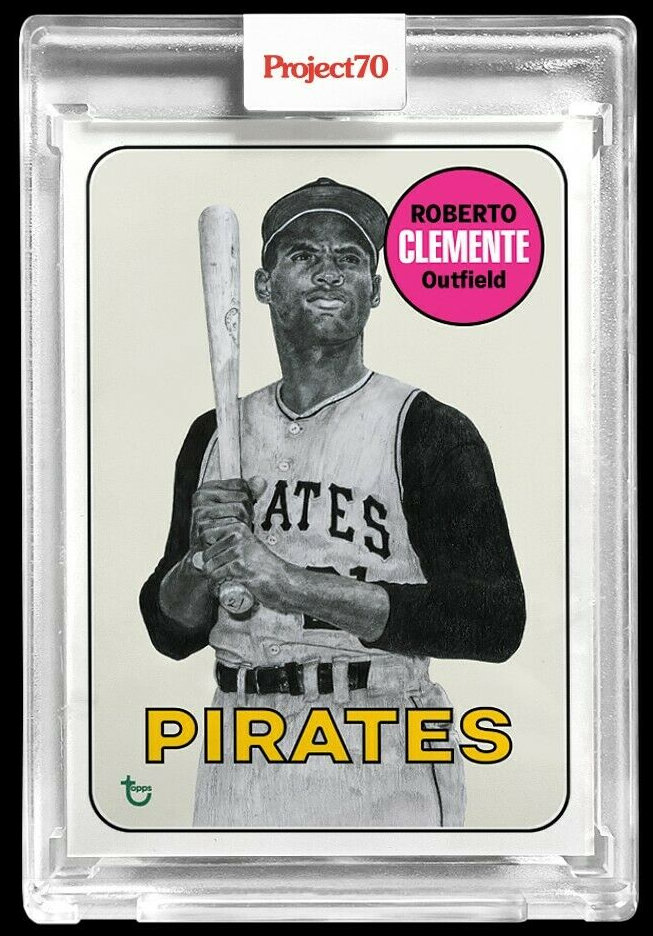
Even Topps in their Project 70 series of cards reimagined the 1969 card with Clemente's given name:

Does that make me part of the "woke" politically correct crowd?  I honestly don't care.  Those type of labels mean nothing to me personally.  I think we should treat all people with dignity and respect.  If they are offended by something you say, do your best not to offend them.  Especially something small like a name.  Whether we're talking about "Bob" Clemente, "Richie" Allen, the Washington Redskins or the Cleveland Indians.  Most times it costs you nothing.  Other times it could be a marketing bonanza.  Just think how many new jerseys, t-shirts, hats, etc. the Guardians will sell this year. 


I have been collecting cards since 1974.  By then Clemente was gone, but I had never heard him referred to as "Bob".  It was odd when I found older cards that had that name.  By 1970 even Topps was calling him Roberto.  For me to refer to him as "Bob" in an effort to be historically accurate to what Topps would have done, is counter to what I put at the very top of this blog.  "What cards would look like if I had my way".  So with my apologies to Roberto Enrique Clemente Walker, here is the card I should have made:


I think it looks just as good as my previous "Bob" Clemente card. And it cost me nothing to show simple respect.


Wednesday, October 27, 2021

1965 World Series: The Missing Topps Set

 For years I've been wanting to tackle this missing piece of the 1966 Topps set.  From 1960 to 1980, Topps has included World Series cards in their sets with notable exceptions of 1966 and 1979. Now 55 years later, I'm making my version of that missing 1966 set. 

Game one the Dodgers were without their ace, Sandy Koufax who was observing Yom Kippur. Instead, Drysdale faced Mudcat Grant.  Grant was coming off a career year with a league leading 21 victories.  But this game was no pitching dual. Each team had 10 hits and all but one starting position player had at least one knock. The Twins iced it early with a 6-run 3rd inning.

Koufax returned for game two but it was Jim Kaat's game. Not only did he deliver a one-run complete game, but drove in two insurance runs in the 8th inning.


Down two games to none, the series moved to Chavez Ravine.  Claude O'Steen pitched a gem, spreading 5 hits over 9 innings to get the shutout.
In Game four the Dodgers evened the series at two.  Despite giving up solo homers to Killebrew and Olivia, Drysdale mowed the Twins down.  For the second game in a row a Dodgers pitcher threw a complete game. 


In the pivotal 5th game, Koufax threw the Dodgers 3rd straight complete game.  He shutout the Twins as the Dodgers took the series lead 3-2.  Maury Wills went 4 for 5 plus a stolen base.  But he wasn't the Dodgers only base running threat, Willie Davis stole 3 bases in game 5.

Game 6 was the Twins turn to showcase their pitching.  Mudcat Grant not only delivered another complete game victory, but contributed with his bat.  He drilled a 3 run homer in the 6th to push the Twins lead to 5-0. Ron Fairly hit a solo dinger in the 7th to provide the Dodgers only tally.


With the series tied at 3, the Dodgers sent their ace to the mound. Koufax threw his second shutout of the series and the 1965 Cy Young Award winner added another World Series MVP to his trophy case.


Monday, December 7, 2020

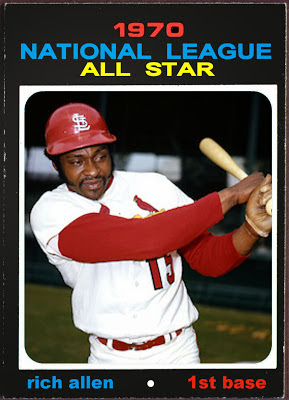
Dick Allen

 1942-2020


It is with great sadness that I learned earlier today of Dick Allen's passing.

This one really stings.  I grew up a Sox fan in the '70s.  Dick Allen was a hero to me.  I had a homemade baseball bat that was just ridiculously way too big.  We called it the "Dick Allen" bat.  I could only use it playing sandlot ball because it was obviously not legal for little league play.  If you follow this blog, you know that I have used Allen as the subject of many posts. The 72 "In Action" was one of my first fake cards. Here are as many others that I can remember making:


Sunday, October 9, 2016

2016 ALDS: Rangers vs. Blue Jays

For the 2016 postseason I am making Cards That Never Were of Hall of Famers from each team but with a couple of twists. The first twist is that they will appear on cards that coincide with the year they were inducted into Cooperstown. The second twist is that these are not the teams they are best known for playing.


1966 Topps Ted Williams

Ted Williams was the manager of the Texas Rangers in their first year. Williams was voted Manager of the Year by the Associated Press in 1969. In his first year as manager he improved the Senators record from  65-96 in 1968 to 86-76 in 1969.  The 1972 Rangers had a miserable 54-100 record under Williams. He was replaced by future Hall of Fame manager Whitey Herzog. He was dismissed in September of '73 when Billy Martin was fired by Detroit. 

This card is an unusual mash-up. Williams was inducted into the Hall of Fame in 1966. The Rangers first year was 1972. Even so, it makes a for nice looking card. 


2009 Topps Rickey Henderson 

Just before the 1993 trade deadline, the Blue Jays picked up Rickey Henderson from the A's for Steve Karsay and a player to be named later (Jose Herrera). Henderson only played 44 regular season games with the Jays. But he played in all 12 post season games and earn himself another World Series ring.  

Here he is on a 2009 Topps Card That Never Was, the year he entered the Hall.  He is wearing the unfamiliar number 14. He wore this only a few games while negotiating a deal with Turner Ward for his trademark number 24. When he joined the Yankees it was rumored that he gave catcher Ron Hassey golf clubs and stereo equipment. Ward got an alleged $25,000.


Thursday, July 21, 2016

TBT - Baltimore Orioles Edition

On the Friday before the All Star break, the Orioles celebrated the 50th anniversary of their 1966 World Series championship. The team sported the same unis as their 1966 counterparts. Their opponents, the L.A. Angels didn't play along and just wore their everyday 2016 away uniforms.

The differences in the 1966 and 2016 uniforms are not dramatic. The main differences being the Orioles script on the '66 uni is slightly different and not underscored and the 2016 caps have a white field behind the cartoon bird. I chose to compare a picture of 2016 shortstop Jonathan Schoop turning a double-play with 1966 second baseman Davey Johnson doing the same. While looking for a Topps card that showed the Orioles home uniforms of this era, I came up short. Perhaps I should say Topps came up short. Although the Orioles uniforms changed in 1966 most cards from 1966-1970 showed home uniforms from 1965 or older or showed the away uniform. 
Rather than use a card from the early seventies to compare the uniforms, I made two Card That Never Were for this post. Davey Johnson was an obvious choice. Topps had included him on a "Rookie Stars" card in the 1965 set, the year in which he made his MLB debut. In 1966 Johnson had earned a starting role as second baseman for the World Series Champs and even a Rookie of the Year nomination. But he didn't earn his own Topps card. Instead he was put on a second, late series "Rookie Stars" card in 1966. So here is a second year card of Davey Johnson that would never have appeared in a 1966 Topps set. It is an action shot of him actually wearing a current uniform.


Thursday, August 27, 2015

Do You "Bunt"?


Apparently, I do.   

I never really saw the point of collecting "virtual" cards. Especially since I've been making virtual cards for this blog for the past 4 years or so. But curiosity finally got the best of me and I had to check out Topps Bunt. To my surprise, I came across this Harmon Killebrew Topps Bunt Card using the same design I used for the 1971 Topps All Star Cards That Never Were.


 Admittedly, the design was not entirely mine. I lifted it from the World Series cards from that set. 


 Nonetheless, I'm kinda stoked that they used a design that I had a hand in creating. 

And I am not the only blogger who's CTNW designs were used by Topps Bunt. Over at The Baseball Card Blog, the writers created a 1965 Topps All Star set. Their design was also incorporated into Topps Bunt.  Here is their design. Basically they made an All Star designation for the regular issue 1965 cards. This is The Baseball Card Blog's version of a 1965 Topps Brooks Robinson All Star card: 


And this is the Topps Bunt version:


On these cards, Topps Bunt utilized the design element that we had also used to create our Cards That Never Were. But on this card of Yogi Berra, the entire card was identical to the one created by Uncle Doc's Closet. Here is the one by Topps Bunt:


And here is the Uncle Doc version:


Did some Topps intern not realize that this was a fake card? Or did he know it was fake and just didn't care? In reality, the design belongs to Topps in the first place and they probably actually paid for the rights to use Berra's image.

I can't speak for the other bloggers, but I am not the least bit upset, offended or otherwise outraged by the Topps Bunt versions of these cards. Quite the opposite. I'm hoping that they use more of our designs. The whole reason I made most of these cards is because I thought Topps should have made them themselves. With the recent addition of Archives, Heritage and now Bunt cards, Topps will have more chances to create the cards they missed the first time around.