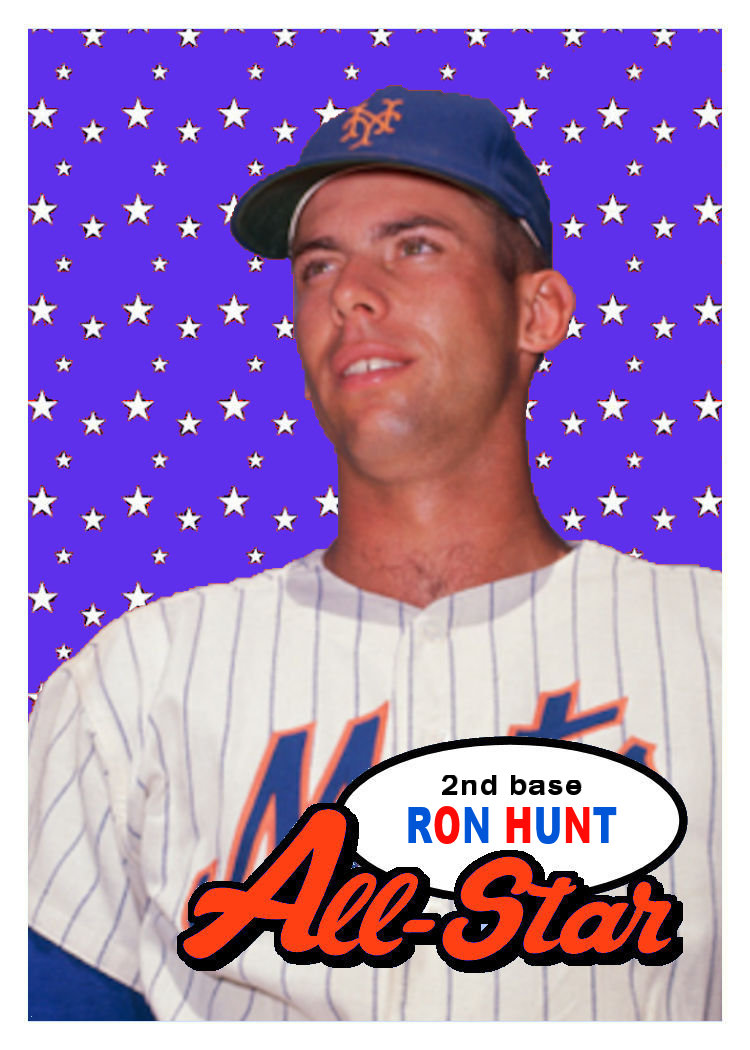
Who probably didn't merit inclusion in the 1969 Topps All-Star set, but was in it anyway?
Jim Fregosi:
Who probably didn't merit inclusion in the 1969 Topps All-Star set, but was in it anyway?
Jim Fregosi:
Topps 1969 American League All Star Infield was another head scratcher. At second Topps had Rod Carew who was the 1968 All Star starter and a 1969 Sporting News All Star selection. Similarly, third base was Brooks Robinson. He was the 1968 ASG starter and a 1969 Sporting News All Star. There if falls apart.
Topps had Bert Campaneris at shortstop. The actual 1969 Sporting News All Star was Luis Aparicio. The 1968 MLB All Star Game Starter was Jim Fregosi.
After a bit of a diversion, I'm ready for another round of All Star misses by Topps. As we've established, Topps basis for the players that appeared on "All Star" cards, often didn't reflect the actual starting MLB All Stars. Many of these cards were labeled as "Sporting News All Star Selections". Unfortunately, that often wasn't accurate either. So I've made cards that could've been included in these Topps All Star sub-sets from 1958-62 and 1968-70.
******************************************************
The 1970 Topps "Sporting News" All Stars featured three AL infielders that started the 1969 All Star game; Boog Powell, Rod Carew and Rico Petrocelli. It also had three from the 1969 Sporting News All Star team; Powell, Carew and Brooks Robinson. Here are some players that could've been included based on either starting the 1969 ASG or being selected to the 1970 Sporting News All Star team:
Davey Johnson:Luis Aparicio:
A request came in for the multi player cards that were a Topps staple in the '60s. In this instance, the request was for the White Sox pitching rotation that included Tommy John, Joel Horlen and Gary Peters. Although the Sporting News had all three on their cover in July of 1967, I could not find a similar color photo. But heck, two out of three ain't bad. I also made a card of the Alou brothers. I used the term Family Affair. That TV show debuted in September of 1966. The Sly and Family Stone hit single of the same name wouldn't come out until 1971.
1964 World Series MVP Bob Gibson pitched 27 innings over 3 games. This included 10 innings in Game 5. His battery mate, Tim McCarver broke the tie in the 10th with a 3-run homer.
I also used a couple of stat categories that Topps wouldn't use on their own leader cards until 1973.
One thing that has been missing in my previous Alt-Topps efforts has been the multi-player card. Topps used them throughout the 50s and 60s. The Aaron Brothers seemed like low-hanging-fruit.
1965 marked the opening of the Astrodome and the name change from Colt .45s to Astros. There were plenty of gimmicks, including a ground crew dressed as spacemen.
The All-Star cards are pretty similar to the base cards. The 1970 All-Star Game logo replaces the team logo. In 1970 Luis Aparicio started his last All Star Game in a White Sox uniform. And what a uniform it was. I always loved the baby-blue flannels of that era.
Meanwhile on the Senior Circuit, the Say Hey Kid was playing in his 21st of 24 career All Star Games. Second only to Hank Aaron and tied with Stan Musial.
Powell had hit a scorcher down first. Lee May bobbled it and threw to the pitcher. Boog was called out. In the mean time, Paul Blair scored from second to put the Orioles up 8-3. The argument and the call had little consequence, but with today's replay, it probably would've been overturned.
Normally I make just one World Series card. The game 5 featuring an umpire just seemed a bit out of place. So I created a series recap card with the typical team celebration.
The 1970 Batting Leader was Alex Johnson who had a career year. Going into the last game of the season he was trailing Yaz by .002. After grounding out in his first at bat, he slapped 2 singles in a row. He was then taken out of the game to preserve his .32899 average over Yastrzemski's .32862 average. Both appear in the stats as .329 but Johnson held a slight statistical edge.
The NL Strikeout leaders feature 3 great Hall of Famers at the top of their game. Tom Seaver, Bob Gibson and Fergie Jenkins. Enough said.
Once again, with 20/20 hindsight, the Rookie Stars cards feature the 1971 Rookies of the Year plus a couple other names you might know. The AL ROY was Chris Chambliss. The Indians chose him with the overall #1 pick of the 1970 draft.
Earl Williams was also taken in the first round of the draft. But that was 5 years earlier in 1965 and with the 6th overall pick. He was worth the wait. He clubbed 33 homers and 87 RBIs in his first full season.
In my previous post I pointed out some other types of cards that might have been included in the 1963 Fleer set had it not been cut short due to Topps' lawsuit. In my last post I added manager, rookie and team cards. But what set would be complete without leader cards?