I am sorry for this delay in requests. These past few months have been crazy both personally and professionally. I know that when a blogger of vintage cards disappears for extended periods of time people sometimes make the logical conclusion that the old goat is either sick or dead. I can assure you that I am neither. Unfortunately, for the next several months, at least, I don't see much time in my schedule for blogging. I do have some half-baked ideas still in the works and will try to get them out when I can.
*******************************************
Here are 18 more cards from the Alt-Topps 1975 set based off that black and white mockup. First off is Walt "No-Neck" Williams who also appeared in my other blog, Rating the Rookies, here. When he passed away in 2016, I created a card for him on this blog, here. I also used his image on a checklist for this blog, here.
Another request, is Deron Johnson. Topps began making designated rookie cards in 1959. Johnson was one of those rookies. He also had rookie cards in 1960 and 1961. I featured his 1960 rookie card in Rating the Rookies, here. This was the only color photo I could find of Johnson in a White Sox uniform, so I had to re-use it for the Alt-Topps version.
For both of these cards, I felt that the black lettering for the team name didn't quite fit. So for the Yankees and White Sox I used white for the team name.


The next two are a couple of players acquired by the Indians in 1974. Robinson was picked up in September. Robinson had been a manager in the Puerto Rican winter league since 1968 and had openly campaigning for a manager's job in Anaheim before being dealt to the Indians. After the season ended, he was named player-manager.
Jim Perry came to the Indians in the deal that send "No-Neck" Williams to the Yankees in March of 1974. Both Jim and his brother, Gaylord, were on the Indians to start the 1975 season. Both also publicly questioned Robinson's managerial credentials. In May, Jim was dealt to the A's for Blue Moon Odom. In June, Gaylord was sent to the Rangers for Jim Bibby, pitcher Jackie Brown, minor league pitcher Rick Waits and cash. Bottom line: Don't question the Judge's bona fides.


 Sonny Siebert began his minor league career in the outfield in 1958-59. In 1960 he moved to pitcher. He ended up pitching in 12 Major League seasons. He had 2 All-Star appearances and pitched a no-hitter in 1966 for the Indians. In November of 1974, he was traded by the Cardinals to the Padres in a 5 player deal. He pitched 17 games for San Diego before being traded to Oakland for Ted Kubiak. He was released by the A's after the 1975 season.
Occasionally, I'll handcuff myself by creating a "rule" for myself. Earlier, I had used shots from the actual 1974 ASG for the All-Star cards. So when requests came for additional cards, the photos were not ideal. For Garvey, I slightly modified it to acknowledge his MVP selection. The Brooks card with Johnny Bench photo-bombing is just not very good. So I created a base card of Robinson , too.


 The base card shows his trademark short-billed batting helmet. When the earflaps were added to helmets in the early '70s Brooks felt that the bill was longer and impeded his vision. So he took a hacksaw and cut about an inch and a half off the bill and also part of the earflap. To my knowledge, he is the only player with this modification. If someone can find another similar helmet leave a comment.
A few requests were for players on the move. After the 1974 season Bonds went to the Yankees in exchange for Bobby Murcer. Northrup was actually picked up by the Orioles in the final weeks of the 1974 season from the Expos. He was an Expo for just over a month after spending the bulk of his career in Detroit. His 1975 season in Baltimore would be his final.


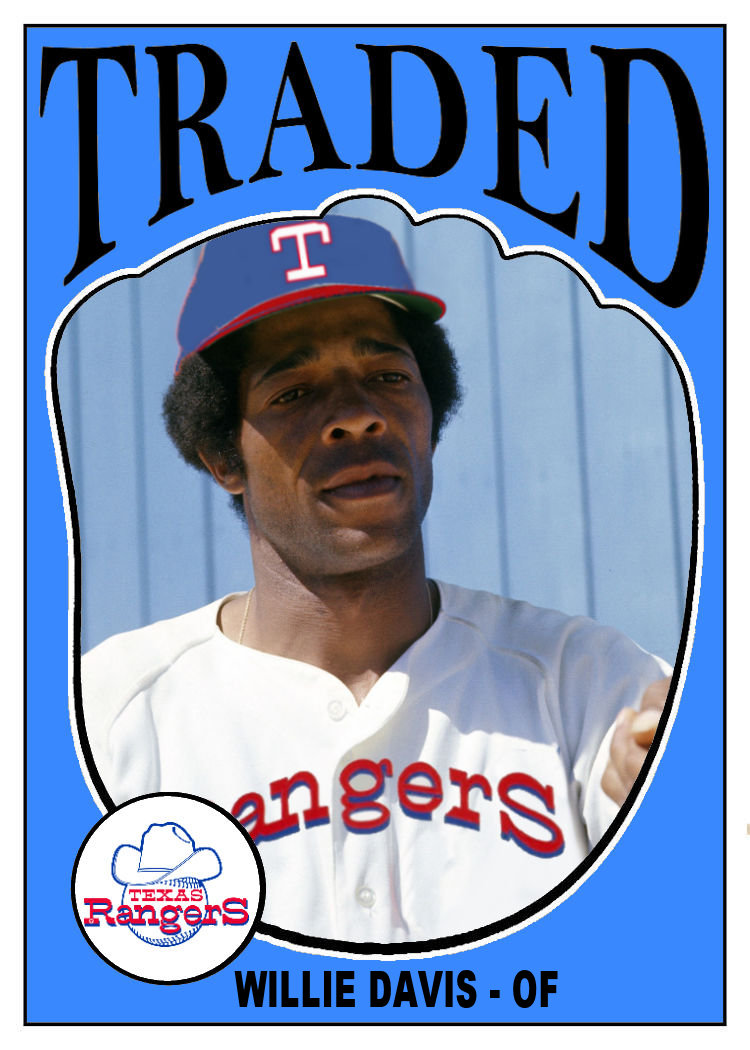
After 8 years as a Met, Boswell was dealt to the Astros. This photo must have been from spring training because he is wearing the old uniform. In 1975 the 'Stros adopted the "Tequila Sunrise" uniforms. Also moving to Texas was Willie Davis. His stay wouldn't be long. By June he was dealt again to the Cardinals.

 By 1975 multi-player rookie cards were the norm. But in 1961 and the first few series of the 1962 set, Topps simply put a star with the year and "rookie" designation. Nobody actually requested this card but with Lynn being the rookie of year and MVP in 1975, he deserved an individual rookie card. I kinda melded the early sixties "Rookie Star" into this Alt-Topps design.
The request also came for post season cards. Of course I couldn't make them all. Instead, I made one more from the ALCS and another World Series card.
 In game 4, Mike Cuellar and Ross Grimsley held the A's to just one hit, a double by Reggie. But they gave up 11 bases on balls, including 3 to Jackson. Meanwhile Hunter and Fingers kept the O's offense in check.
 In Game 2 of the World Series, Don Sutton threw 9 strikeouts and shut the A's out through 8 innings. But in the 9th he hit Sal Bando then gave up a double to Jackson. Mike Marshall came in and gave up a single to Joe Rudi that scored Bando and Jackson. "Designated Runner" Herb Washington came in to run for Rudi. Marshall Struck out Tenace, picked off Washington, then struck out pinch hitter, Angel Mangual to even the series.
These last two are "kind of" a request from Buzz. He wanted a Graig Nettles card in the glove design. I got me to thinking that maybe I could put together some "Gold Glove" cards similar to the leader cards. So I tried to create a gold-foil-type look that was similar to the leaders cards I made earlier.
 It is a fairly recent practice of breaking down the outfielders by specific position (2011). In 1974 of the 6 gold glove winners for outfield 4 were centerfielders. The exceptions were Joe Rudi, LF Oakland and Bobby Bonds, RF San Francisco. Cesar Cedeno, HOU, Cesar Geronimo, CIN, Paul Blair, BAL and Amos Otis, KC were all centerfielders.
 Jim Kaat was a perennial Gold Glove winner. He was honored 16 consecutive years from 1962-1977. In the NL, Andy Messersmith won his first of two Gold Gloves despite committing a career high nine errors.
  Unfortunately, Graig Nettles first Gold Glove wouldn't come until 1977. ( A little competition from the "Human Vacuum" at the hot corner). Here is the card that Buzz actually wanted. This was the best shot I could find to fit the format of this set. Since this design doesn't translate well to a horizontal adaptation, most action shots of Nettles had him diving right off the card.


